
A few months ago, I was given a gift – The Bonsai Handbook, by David Prescott. I have always been interested in the art of Bonsai, but never took enough interest to actually DO Bonsai. After reading the book, I decided it was about time I made an attempt.
Many of us have had the unfortunate experience of purchasing a Bonsai at some local store only to find little instruction on management with the predictable result of almost immediate death of the poor thing. How finicky can these silly things be, I wondered? I went to the Des Moines Botanical Center and spent a good deal of time studying their rather large collection of Bonsai and, based upon what I read there, and how they had them set up, I thought it must really not be that terribly difficult as long as one pays close attention to the process and tends the plant frequently. Perhaps, though, that is the definition of difficult when it comes to plants.
The Bonsai Handbook confirmed my suspicions as I read through it at breakneck pace and discovered that, with a little modification to take into account the severity of Iowa winters, I could more than likely manage to create my own Bonsai. In fact, I knew just the little tree to consider – a small five-year-old Japanese Fern-Leaf Red Maple that had been struggling year after year under the heavy weight of Iowa’s wet winter snows; it was all gnarled and scrawny for its age, but tough as the dickens, and the trunk was about the right diameter.
So, I dug it up and found, to my delight, that this little tree has the most fantastically interesting clump of “nebari“, or large twisted roots at the base of the trunk; it’s these roots that make the trunk particularly interesting artistically, and also enhances the value of the Bonsai.
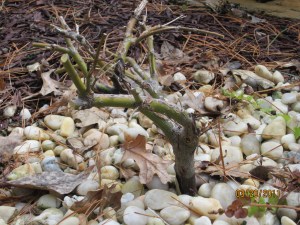
Fern-Leaf Japanese Red Maple—only about eight inches tall after four years due to struggles with winter snow.
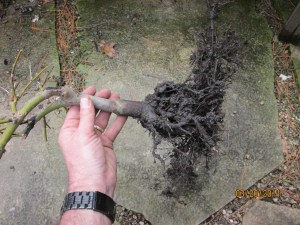
The root structure after washing and removing the dirt from the roots and trimming the long roots away.

A very interesting gnarl of nebari, or large roots to leave exposed upon planting.
I made the decision to go with an oblong shaped pot six inches deep – deeper than is usually used for Bonsai, my reasoning being that the recommended lowest temperature for the Bonsai is 14 degrees F, a temperature significantly higher than the lows one might see here in Iowa of -20 on occasion. Deciduous Bonsai must have a cold winter dormant period, and the only place that will work for any Bonsai I create for outdoor dormancy is the south side of the house where the pots can be kept slightly warmer than the ambient air temperature. A deeper pot will likely prevent root damage from too low temperatures, especially if the pots are heavily mulched for the winter. On the other hand, we often see temps as high as 100 degrees in the summer, a temp so high that even in the shade a poor little Bonsai is likely to need to be watered constantly, so the pot will need to be embedded in mulch for the summer as well to prevent the soil drying. I have to take all these factors into consideration when determining the best plan of action. A plastic pot will be necessary instead of ceramic as ceramic usually cracks here with these weather extremes.
After trimming the roots, the next step was to place the tree into the pot before the roots had a chance to dry out. I put a two-inch layer of large stones in the bottom and filled the pot with a combination of garden topsoil and black loam from my garden, mixed with some vermiculite. This is not the usual formula, but again I had to take into account weather conditions here in Iowa, so wrong or right, that’s what I did. I then carefully placed the tree and trimmed the branches, carefully tamping the soil down around the roots and leaving the nebari beautifully exposed. Then I collected red lava stones, white marble stones, and patches of moss growing around my house here and there to finish off the top of the soil.
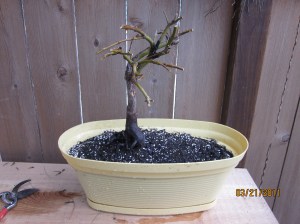
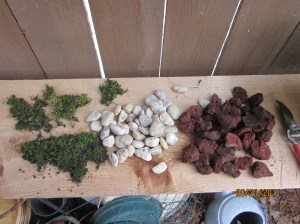
I then began the process of making it pretty, carefully dividing and poking the moss into the spaces between the nebari and around the base of the trunk, and then finally placing red lava rock on one side and white marble on the other. The tree has branches only on one side, and I decided to take advantage of that fact in the following way: the bright red leaves will be in striking contrast to the white stones underneath the branches, and the red lava stones on the opposite side will balance the red of the leaves hovering over the white stones. The branches will be wired to grow only in one direction to give the impression that the tree is blowing to one side, much like one sees with old trees that have dealt with a prevailing wind all their lives.
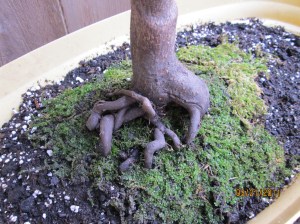
The nebari come to life with the addition of bright green moss!
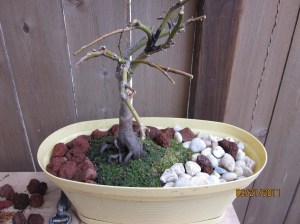
The final soil covering of moss, lava rock, and white marble. The tree is slightly to one side to allow for the growth of branches to the right only.
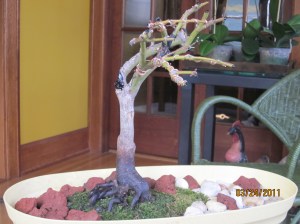
A final artistic trim and wiring of some of the branches with copper wire, and the Bonsai is safely ensconced in the conservatory, away from squirrels!
The final step was to artistically trim a few more branches and carefully wire them with copper wire to begin the process of forcing them to grow in the correct direction. Finally, I brought the whole thing inside where it will be safe from varmints as it re-establishes its roots and begins leafing out for spring. I hope it works as well as I imagine!
For the second Bonsai I chose an old Daphne ‘Carol Mackie’, a variegated variety of the Daphne shrub. I have no idea how this will work – since it’s a shrub, and not a tree – but this shrub needed to be removed anyway and I decided to give it a try. It has some really interesting branches and an old, fat trunk with a big swath of dead wood in it extending way up into some of the branches. This dead wood effect, or “shari,” is very interesting visually. A “jin” is a sharp spike at the top of the main trunk, a characteristic that is particularly nice on pine Bonsai. At any rate, I went through the same process with the Daphne, and also carved out some of the dead wood to make it look like an ancient but miniature giant tree, and then wired the smaller branches extensively to create additional visual interest. If it works, this could be an incredibly beautiful specimen. Daphne bloom in the spring with pale pink, fantastic-smelling clusters of flowers. We’ll see what happens!
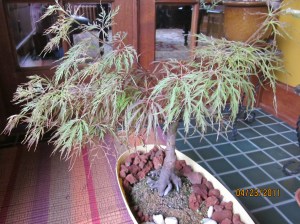
Here is the red maple a couple of weeks later, growing like mad. It is usually a very deep purple, but it has less light in the house where I put it for safe keeping. I will put it outside the first week of May.
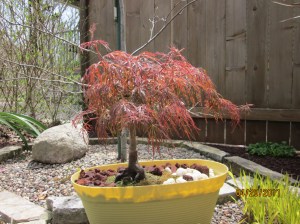
… and now outside for a few days with some real sun and true color!
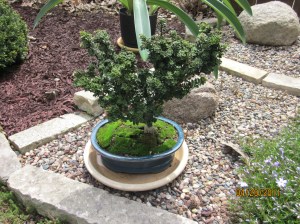
And just for fun, a new addition – a Dwarf Japanese Holly. Slow growing with great leaf structure. I used the same technique but a traditional Bonsai soil mix and a more standard pot.
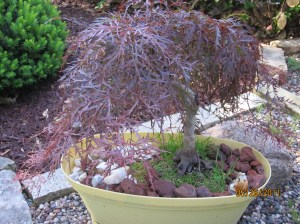
End of May. Great growth and color. The moss is beautiful. A little ceramic man has been added to complete the scene.

Amaryllis. Plant the bulb at Thanksgiving and this is what you have at Christmas. Plant it outside in the spring, dig the bulb in September, cut the top off, and store it in the garage until November 1st and plant it again!
It’s not that hard. Seriously.
1. Find the correct space. A room with East AND South windows is preferable, without buildings or evergreen trees blocking the low-angle sun that comes in during the winter. If the room happens to have a bathroom attached, that’s even better. The shower can be used to periodically steam the air, and plant watering becomes much easier. Make sure the windows are properly sealed to avoid winter drafts. If the windows are screened it is great for allowing in outdoor air on warmer days. An old closed in porch can work pretty well provided it is properly insulated and has a heat source. Indoor plants need higher humidity during the winter months, about 60%. A humidifier may be necessary to achieve this.
2. Find some narrow glass and steel tables of whatever length is necessary upon which to place the plants. A table called a “Parsons Table” is ideal and can be located at a number of stores on the internet which will provide custom lengths and widths. They are not terribly expensive.
3. You will want to sit in your conservatory. I like a porch-like feel, so found wicker furniture to enhance that ambiance. A little coffee table is a necessity, as you will need to drink coffee in there when the sun is coming up, and read books there in the afternoon. ESPECIALLY if you’ve added a little indoor fountain for some background water sound – available at all the garden centers and all over the internet. Small ones don’t cost much.
4. Find a space heater if needed – the type that just sits there and looks like an old-fashioned radiator. All the hardware stores have oil-filled ones with thermostats that just plug in for particularly cold nights. The heat from these goes straight up, pulling cold air down from the ceiling and keeping air moving even though it has no fan apparatus.
5. It’s okay for the room to get cool at night, preferably down around 55 or 60. The room will warm up drastically on sunny days, and the temperature variation is good for the plants, so if the room has a door to separate it from the rest of the house, leave it closed. A lot of tropical plants need a period of cold nights and warm days to stimulate blooming, particularly orchids. And don’t over-water! Your plants will slow down over the winter, and the roots will be cooler. Standing water or soaked soil will kill them. Go easy on the fertilizer as well; you can begin adding that back in around March when things heat up again and your plants get excited about growing.
6. In the summer your plants will nearly all be outside, or they should be! Move them out! They will go crazy and look spectacular when brought in by October or November. Put them out as early as possible but be aware of the sun; it will cause terrible sunburn for plants which have been inside all winter – they must be eased into it if direct sun is necessary. This is true even for cacti and desert plants, so put them in light shade and gradually ease them into the light. In the Fall I always have a “staging area” on the back step where the plants I’m bringing in are cleaned up and re-potted if necessary. I gather them there when frost and cold weather seems imminent and watch the weather reports carefully. I do not bring them in until nighttime temps are hitting 45F.
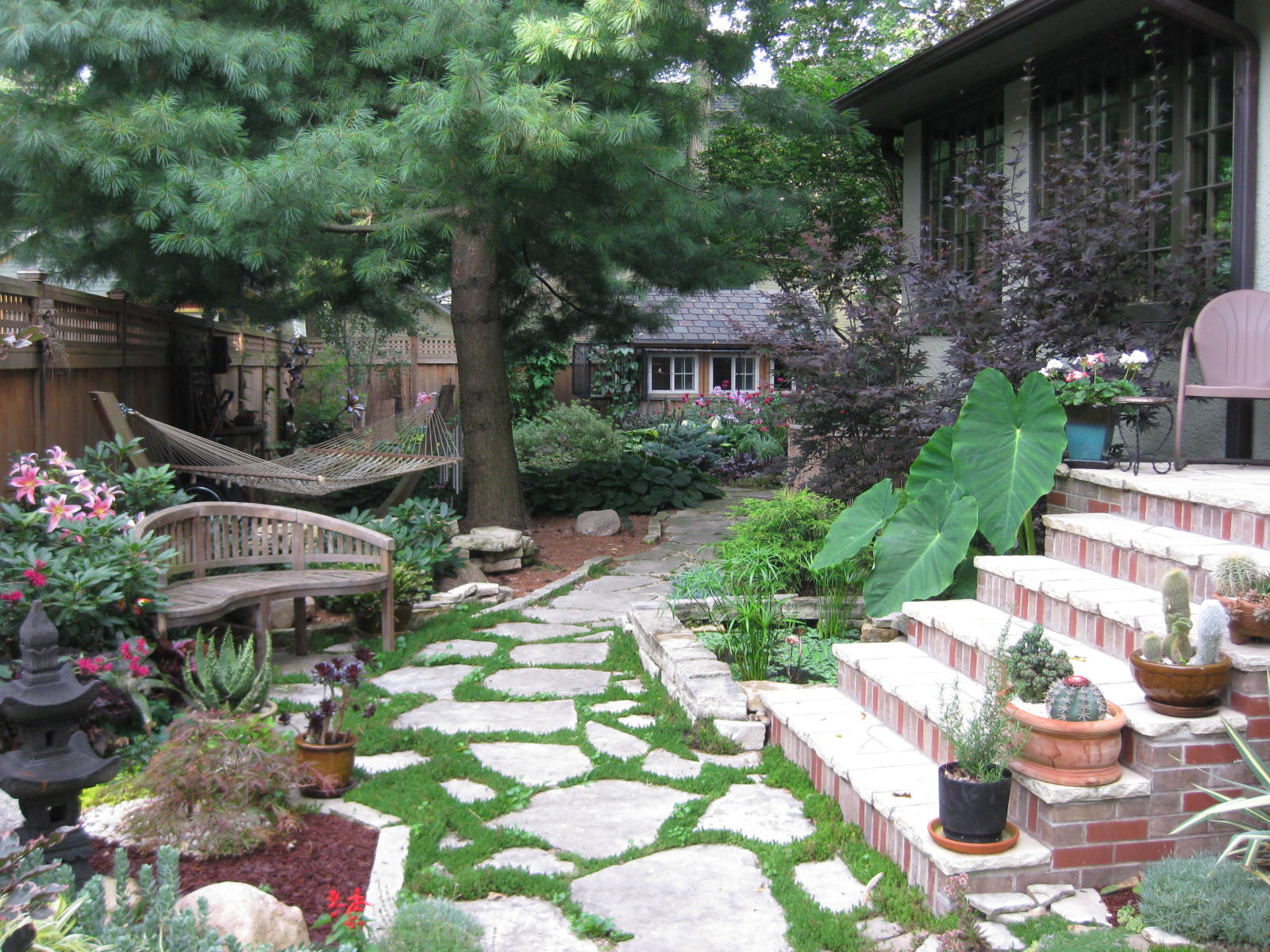
This is my Fall “Staging Area”. I put all my indoor plants on the steps for cleaning and re-potting; the door to the conservatory is conveniently located at the top of the steps.
7. Now, arrange your furniture, and make it cozy. A room as small as 8×8 feet will feel like a jungle if done properly! And you’ll fit in it just perfectly. Be creative. The tables do NOT have to go along the wall. They can be perpendicular to the wall. You can even stack them if you want!
8. Pick plants that are easy to manage over the winter that will give you some beautiful blooms. Christmas Cactus and Amaryllis Bulbs are great for Thanksgiving and Christmas; orchids take off in January and February with spectacular blooms. Other good choices are Passion Flower vine (which will climb to the ceiling), Norfolk Island Pine, Bromeliads, all sorts of Cacti and succulents, and African Violets for color all the time, though they are a little more finicky. Personally, I like to get spectacularly blooming plants for the Conservatory, and weird plants that no one else has.
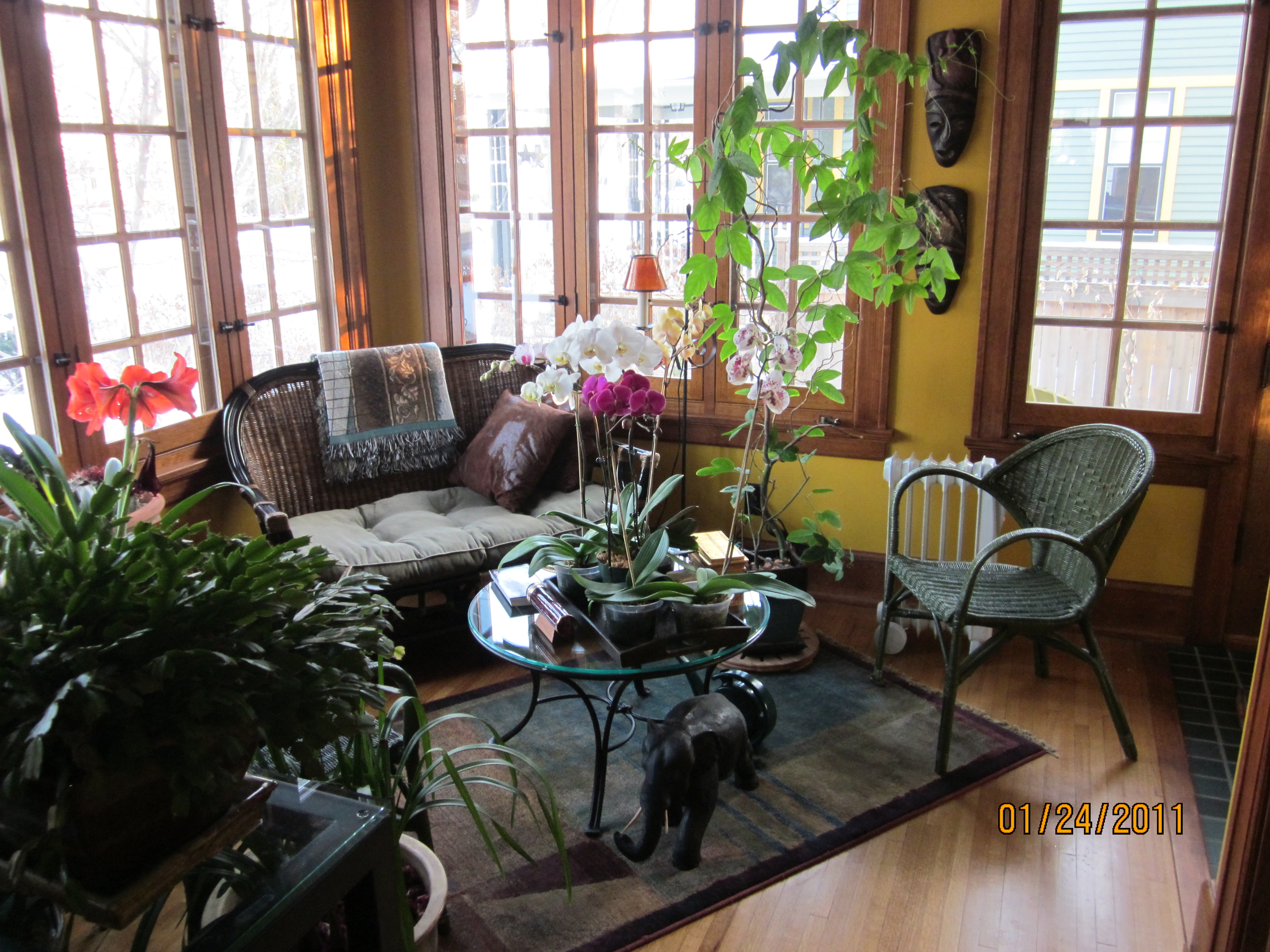
Everything described in this article is in this room.

I know … hideous, aren’t they.
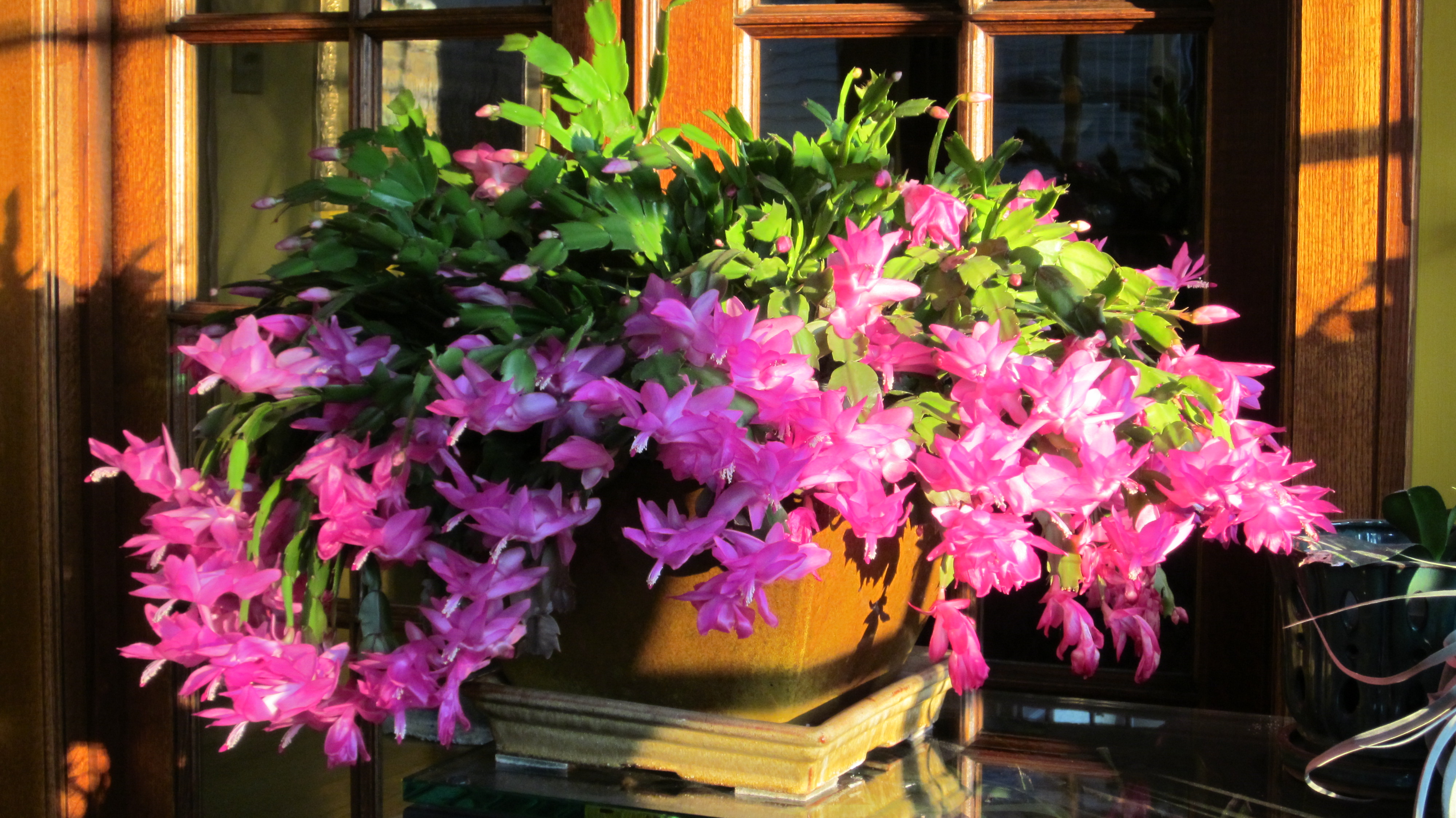
Beautiful! This Thanksgiving Cactus blooms like this every Thanksgiving. I leave it out from April until mid-November, and this is how it rewards me!
9. If you want to go crazy, get some animal carvings, African masks, butterfly prints, and so forth for the walls and floor here and there.
10. The only problem with your Conservatory will be that everyone will want to be in it all the time. Remember, it’s a special room, because you’re the gardener, and you did all the work to make it so perfect! Enjoy it!
A pigeon loft need not be difficult or gigantic, but it should definitely be aesthetic to the surroundings in which it is placed. I converted a little garden shed to suit the needs of my pigeons, and it works quite well. The shed is portable and rests on skids, so it can even be moved if needed. It was built by VanWyk Builders on the south side of Grinnell; these guys do great work and build all sorts of neat little sheds, cabins, storage buildings, gazebos, and etc. and will do custom work when asked. In my case, they came and built the shed right on my property because I didn’t want my gardens all messed up dragging a pre-built one into the back yard. Even with that, the cost was quite acceptable. I had them place lots of windows in it and electrify the building, then had it spray insulated for comfort. All I have to do for electricity is plug the building into an outdoor socket on the house. The 8×10 size of the shed is pretty minimal for a Fancy Pigeon loft I think, though I’ve seen smaller. It is made of cedar for long-term weather resistance.
Travelling in Europe I saw some amazing stone dovecotes and pigeon lofts; some were round and looked like short silos, and others were stunning little cottages. The Europeans really get into their pigeons and pigeon loft design. There are lots of designs to view and study on the internet, and anyone interested may be able to find other information from various pigeon fancier magazines and the National Pigeon Association. Purebred Pigeon magazine occasionally has articles written by experienced pigeon fanciers regarding their building design for lofts.
In the summer of 2010, I added a flight to my little pigeon loft to give my birds lots of fresh air and some “flapping” room, because a loft without a flight is just not really complete. I would love to just let them out free to roam, but one never knows what might happen to them with all the cats and varmints running around. I was recently talking to a friend of mine who happily accepted a number of my birds that I could not keep for breeding; he had a great set-up with a little loft on the farm where they could get out and about and fly free. I went out a couple of times to watch them. Of course, they were a beautiful sight to see winging about in the sunlight. So beautiful, in fact, that a few weeks later he found half of them were gone, as they had caught the eye of a pair of sharp-shinned hawks, one of which was calmly devouring one on the branch of a nearby tree, white feathers drifting by the hundreds to the ground. This is the problem with “showy” birds in the wild, and especially pigeons. They have a multitude of predators already; throw in a lot of color and contrasting white, and you have a meal in a suit; may as well wear a sign that says, “eat me.” So, mine will stay behind bars. His, however, will be allowed out when the hawk migrations are past, and it will be survival of the fittest.
In the past I’ve built my own aviaries out of all sorts of materials from wood and wire mesh to PVC pipe and high-grade aviary fencing, depending upon what sorts of birds I was keeping. I also once had a custom-made indoor glass and oak aviary made by a gal in Texas for my parrotlets. The last outdoor aviary I had was used by my pigeons as well as Gouldian finches and canaries, so I used a very fine mesh screen on the outside and a heavy plastic square fencing on the inside with a wood frame; the roof was wire mesh covered with willow fencing. It looked like a little Hawaiian beach minibar. It was great until we got about 80 inches of snow in the winter of 2009-10 which was so heavy it caused the roof to collapse. So, I made window aviaries to hang on the side of the loft. These work great – made of wire mesh and PVC pipe, they are light and sturdy and merely hang on the side of the building over the windows on hooks. The birds alight on the windowsill and hop out onto the mesh floor. The only problem is that they cannot be made very deep, or they will sag.

Hanging small aviaries or flights off the side of the building is convenient and easy and allows for lots of exercise and fresh air. This technique is best for small birds.
Eventually I changed tactics and obtained outdoor dog run panels to make the flight for my pigeons. The panels are 4×6 feet, one of which contains a door within a door. The roof is flat and also made of panels. Each panel is covered with a black powder coat; this is important, as the best bird observation in an aviary can only occur if the aviary panels are black, as otherwise there is too much light reflection off the wire, and it is a terrible visual distraction. The individual squares in the panels are 2×4 inches.
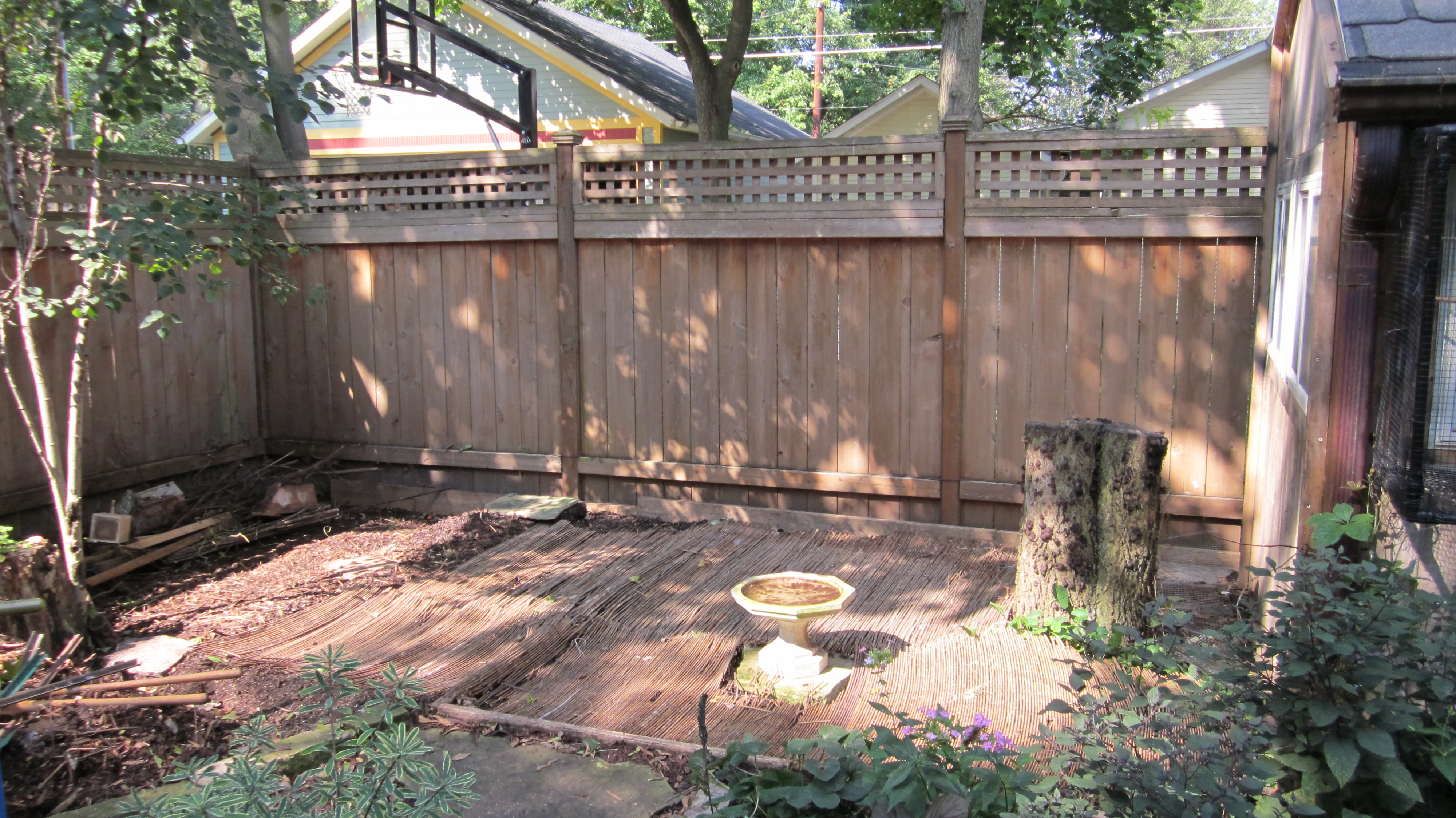
Here’s the site – 8X12 feet. I changed the garden path so it will come to a door in the center for easy access. I put old willow fencing on the floor to avoid mud. A bird bath will be available.
The following pictures show the 8X8 foot dog-run panel version (temporary while waiting for more panels to arrive) and the 8 X 12-foot version. Under the windows is a 2×6 pine board hung onto the wire panels with a couple of nails in each end. It’s easy to move and remove, and the pigeons really prefer to have a landing board both going in and coming out of the loft. The bird bath is a big plus, as they use it daily. The willow fencing on the ground keeps their feet and leg feathers clean. They love being outside. There is the possibility of extending the flight to 16 feet; the more outdoor flying the better.
This aviary is incredibly easy to get in and out of since the door is nice and wide and opens in and out. Because of the design and the easy to apply clamps for putting the panels together, one could make any number of shapes as well, including an L-shaped flight. For those who are interested in urban chickens for home-grown eggs, it would work perfectly for that as well! (Just check with the city council first to make sure your town allows it.)
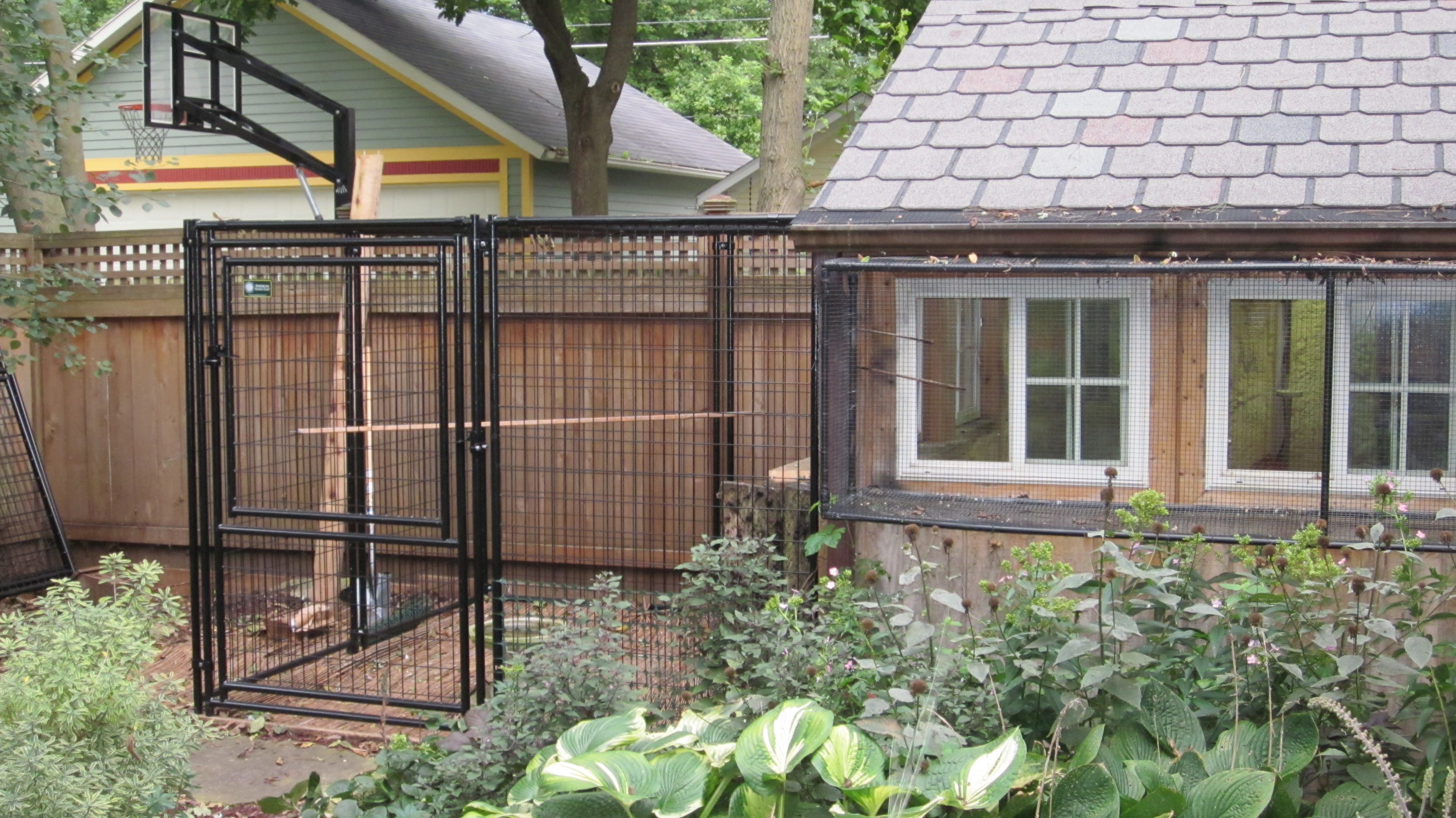
The almost completed new aviary! The access door at the end of the path has a second half-door so one can reach inside to fill the bird bath without walking all the way in. It is a great design for larger birds, even though it is sold as a “dog-run.”
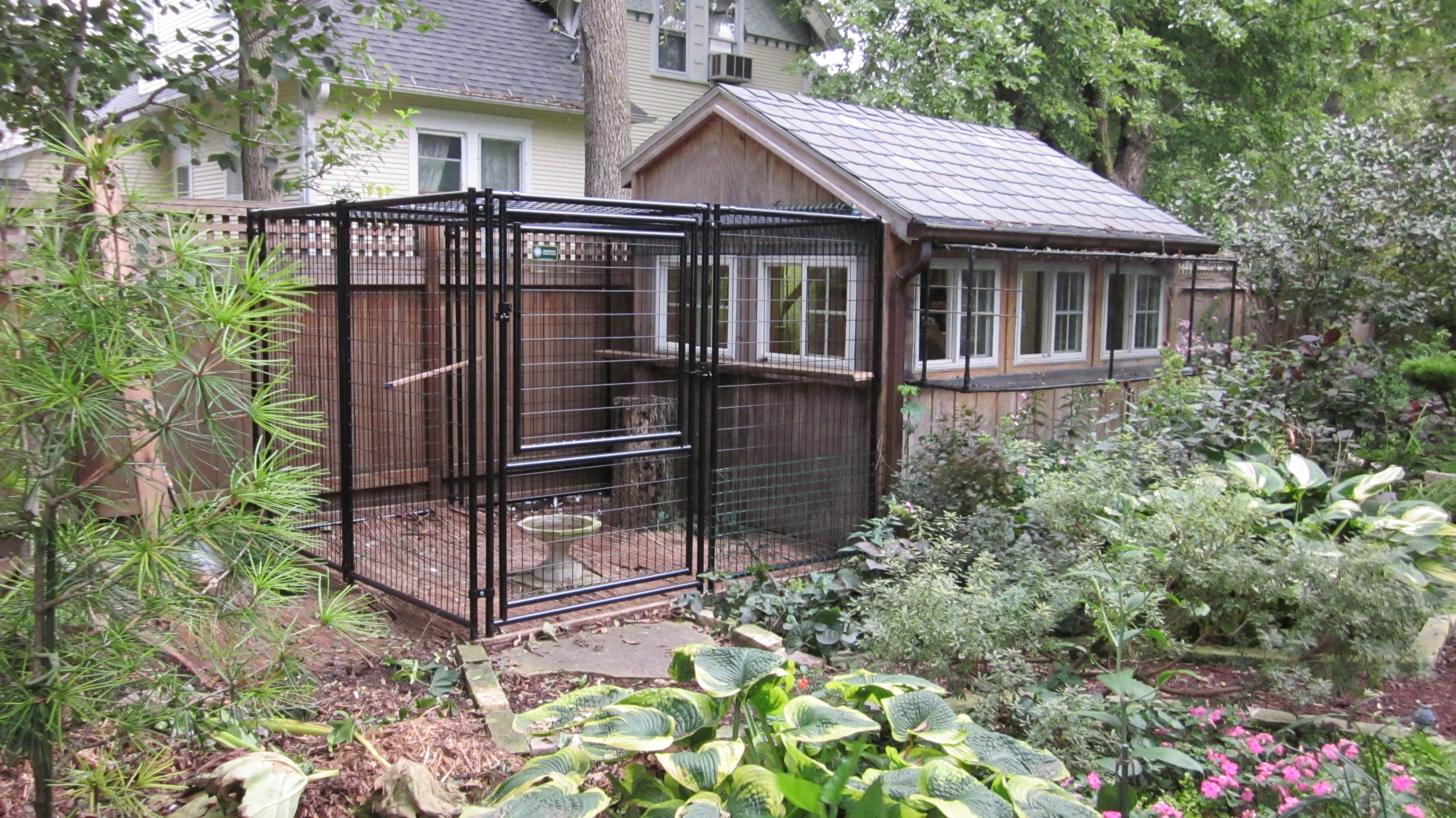
Another view. I really like how the aviary is nestled into this space with gardens and specimen shrubs all around.
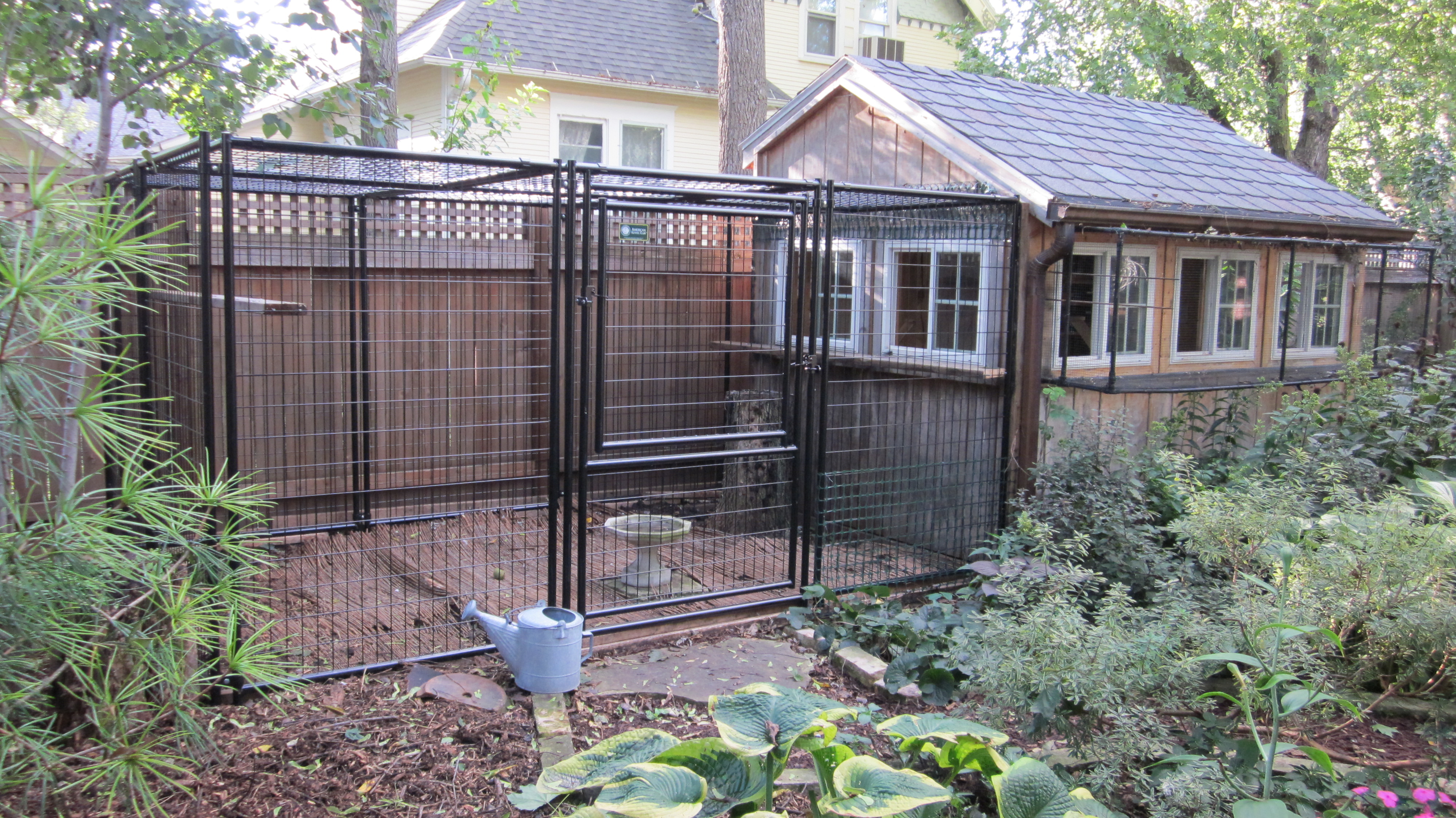
Here then is the final 8X12 foot version. It has a ceiling of the same panels and was incredibly easy to put together. It is rugged and rust-proof. The birds love being outside and spend all day out there now.
Anyway, this flight looks very nice and professional. It’s important to have some trees and shrubs and flowers around to soften the effect of tubular steel. These panels are amenable to window boxes for flowers on the outside. Don’t forget this if you use this approach! Keep in mind that some varmints can get through this sort of panel, as the openings are two inches wide. Obviously, mice and chipmunks and young squirrels, but also a much more deadly critter – the weasel or mink. So, keep in mind that the loft should be closed up tight at night. Furthermore, don’t feed the birds in the outdoor flight – it will be an unnecessary attraction to some of the pests I mentioned.

And here, in the last photo, is the scene the following spring of 2011 with the aviary fully integrated into the landscape. Ferns have grown up around the perimeter, and a Passionflower vine in its pot has been allowed to grow up and over the wire; a clematis is doing the same nearby along with Virginia Creeper, and I’ve attached some air ferns to the cage for additional softening of the “square” effect of the steel. Glazed giant copper flower sculptures have been “planted,” and native woodland plants have grown in everywhere. I seeded the entire floor of the aviary with shade tolerant grass where the pigeons like to lie on warm sunny days, wings spread out.
In the year 2000 I was attending a family reunion at my mother’s house in southeast Iowa. It was a hot July day, and everyone was outside on the lawn enjoying the shade of the big River Birch while chatting and drinking iced tea. A lot of people had come that summer of 2000, including my Great Aunts from Florida, Missouri, and other parts unknown. I didn’t really know these aunts. They were in their upper 80’s and 90’s but as spry and sharp as one can imagine, with clear blue eyes to match their blue hair. I was chatting with a cousin while my mother talked to the oldsters nearby when above the general din I overheard some snippets from the adjacent conversation: “Marlene Dietrich – oh, I don’t know – well, it’s ridiculous. l – we – just don’t talk about her anymore, even if she IS our cousin.“
Marlene was one of the most famous American movie stars ever, with a career that spanned from the 1920’s through the ’60s, and even beyond. I turned and looked at the group. Mom was in the circle with them and seemed to be in the know. I walked over. “What are you talking about Mom?” “Oh, nothing,” she replied. “It didn’t sound like nothing to me! I thought I heard one of you say that Marlene Dietrich is our cousin.” They all stood looking at me, blinking for a moment, then one of them finally spoke up. “Well, she IS our cousin, but we don’t want anyone to know it, and we just don’t talk about her. I don’t know why we’re talking about her now!” They laughed. I was astounded. “What do you mean you just don’t talk about her? And how is she your cousin? And why didn’t I know this?”
“Well, she’s a close cousin. Her mother is a Felsing just like us, and we have the same ancestor, Conrad Felsing from Berlin. And we don’t talk about her because she’s a bad girl.” “What do you mean she’s a bad girl?” I asked, even more incredulous, “She’s a movie star!” “WELL!” they replied, “It’s nothing we can talk about out loud! Let’s just leave it at that!”

Marlene Dietrich in the 1940’s.
In a moment, I grabbed Mom and pulled her aside and asked her just exactly when she planned to tell me that we were cousins of Marlene Dietrich; I was 40 years old, and she was 65 and I was completely unaware of this connection. She said “never” – she just didn’t think it was important. Her father, Paul Felsing, my grandfather, was Marlene’s cousin on Marlene’s mother’s (Josephine Felsing) side. “We just think the sort of things she did were not always in the best taste,” she said.
Of course, by 2000 Marlene had already been dead eight years, having spent the last years of her life as a recluse in Paris. She died there in 1992 at age 91. After her death her body was returned to Berlin, where she had grown up. She had been on the outs with the Germans for years because she was so outspoken against her own people for their fascism in the years leading up to World War 2. Hitler tried to force her to come back to Germany from the United States, but she refused. Instead, she worked with other women to support the United States and went to the front lines to perform for American soldiers when they were stationed throughout Europe. At the time of her death her body was returned to Germany where the Germans turned out in great numbers to honor her and throw flowers on her casket as the procession went through the streets.
It turned out that I didn’t know enough about Marlene, so I bought a biography and any other information I could get my hands on, and sure enough, her family tree includes my great grandfather. She was – as my family put it – a “bad girl” because she was a feminist who smoked, wore both men’s and women’s clothes, slept with both men and women, maintained an unconventional marriage, worked in film, was a savvy businesswoman, did exactly whatever she wanted, and “wasn’t really a Christian.” She was a woman who knew who she was, a woman who could stand on her own two feet in a patriarchy. Some of her extended family emigrated to South Dakota (where my grandfather was born) from Germany in the late 1800’s. Her family owned the Conrad Felsing Clock Co. in Berlin. My husband went online to investigate and found an old Felsing clock in Colorado, made for the Parisian market. It was carted over to the United States by a GI returning from World War 2. It sits on a desk in my home today, and it still works.

My Turn-of-the-Century Felsing Clock, designed for the Parisian market.
In the summer of 2010, I went to Berlin for the first time. Of course, there is nothing left of the Conrad Felsing Clock Co. store at 20 Unter der Linden avenue where Josephine Felsing, Marlene’s mother, was living when the war ended, but nonetheless I tried hard to imagine what it must have been like to live in Berlin in the early 1900’s when she was there, having watched all the Marlene films and documentaries I could find. Eventually I walked down to Potsdamer Platz where the Marlene Dietrich film museum is located and spent a great deal of time going slowly through, looking at movie clips, clothing, and accessories and reading personal notes of hers. She was a lot taller than I imagined, and incredibly beautiful.
And what an interesting and full life Marlene had! She was ambitious and unusual, smart and accomplished, and to call her a “bad girl,” as my older relatives did, diminished the complexity of her life and the contributions she made to society, culture, and the world. After the museum, we wandered down to the gay neighborhood around Nollen Dorf Platz in Schonberg (where she is buried), Here she performed in one of the local bars in her twenties, and we explored that area too. So much history there! The writer Christopher Isherwood stayed in that same neighborhood in the 1930’s and he must have known of Marlene. His “Berlin Stories” are based on his experiences there and are, of course, the basis for the musical “Cabaret.”
In 2005 I sat for a portrait with Don Bachardy – Christopher Isherwood’s artist partner – in Santa Monica. Don had been introduced to – and painted a portrait of – my partner, Kevin, back in 1999; they had a mutual acquaintance who introduced them. Don happily agreed, per Kevin’s request, to paint me as well when we visited Los Angeles. So, I spent a day in Isherwood and Bachardy’s house and art studio, completely ignorant of the fact he had drawn Marlene Dietrich’s portrait too at the same place way back in 1963 when I was just 3. Later we had dinner at a little diner down the street that you can see in the movie “A Single Man,” a film based on the book of the same title by Isherwood. Don Bachardy is a really interesting and kind man, and an amazing artist. He is very old now, and Chris has been gone for many years, as he was much older even than Don. Anyone interested in the lives of these individuals can get the documentary “Chris and Don” through Netflix, as well as at least two good documentaries about Marlene.

Christopher Isherwood and Don Bachardy.
The photo of Chris and Don at left is, of course, old. Living life as an out gay couple at the time this photo was taken was not easy and was fraught with potential danger. They had some security because of their connections and work, but they still had to be careful. The gay community was mostly hidden. My father had a first cousin who died in 1979 who was in his late 70’s; he was a gay man and very accomplished – an author, artist, musician, and more, who had traveled the world. Did I know him? No. I was never allowed to meet him! I knew nothing about him until he died and then was given only sketchy information because his gay life was just something not talked about, and the family found it embarrassing. It’s upsetting, frankly. Most of his papers were destroyed, and only fragments remained in his home of his art, books, diaries and letters – just enough to convince me that knowing him would have enriched my life. I eventually tracked down all that remained of his legacy at the University of Iowa’s historical archives, obtained one of his paintings, read his diaries and letters, and found a person – Gretchen Spencer – in Des Moines, who knew him and had spent a good deal of her life trying to reconstruct the history of his life. After my research, I wrote up a biography of my findings, which you may now see on this site, entitled “Artist Lee Ver Duft 1910-1985.”
Lives touch and reconnect across time and generations; how often we don’t know the connections or importance of certain events and experiences until much later! And how often we don’t know what we missed or lost entirely! I am fortunate to at least finally know as much as I do, and incredibly fortunate to have met Don Bachardy – a direct connection to Marlene Dietrich – an artist who met us both and captured us on paper 42 years apart.

In 2015, my husband Kevin, a professor of English and a Critical Theorist, was asked to write an article for The London Review of Books about the new book, “Hollywood,” by Don Bachardy. The book is a compilation of drawings of Hollywood stars by Don Bachardy from throughout the decades of the twentieth century, a book that, of course, includes the original drawing of Marlene Dietrich. Here is the link to Kevin’s article: https://www.lrb.co.uk/the-paper/v37/n07/kevin-kopelson/all-about-me. It is pertinent to this story.
We’ve all had this happen. You plot and scheme and dig and plant and have everything laid out exactly the way you want, and for some reason there is one small area that doesn’t turn out right. It looks ridiculous, the plants are bigger or smaller than expected, the soil conditions are wrong, the colors are wrong, there’s too much sun, there’s too much shade, and blah blah blah.
So, what do you do?
I had a spot like that beside my steps – a little area just about eight feet deep by six feet wide, nestled under the overhang of the house. It was bone dry against the foundation, sopping wet in one spot where heavy rains always overflow the gutter above, burning hot in mid-day, and in complete dark shade the rest of the day. Insane! What can you do with an area like that???
Well, after many mistakes, THIS is what I did with it – a miniature rock-garden!
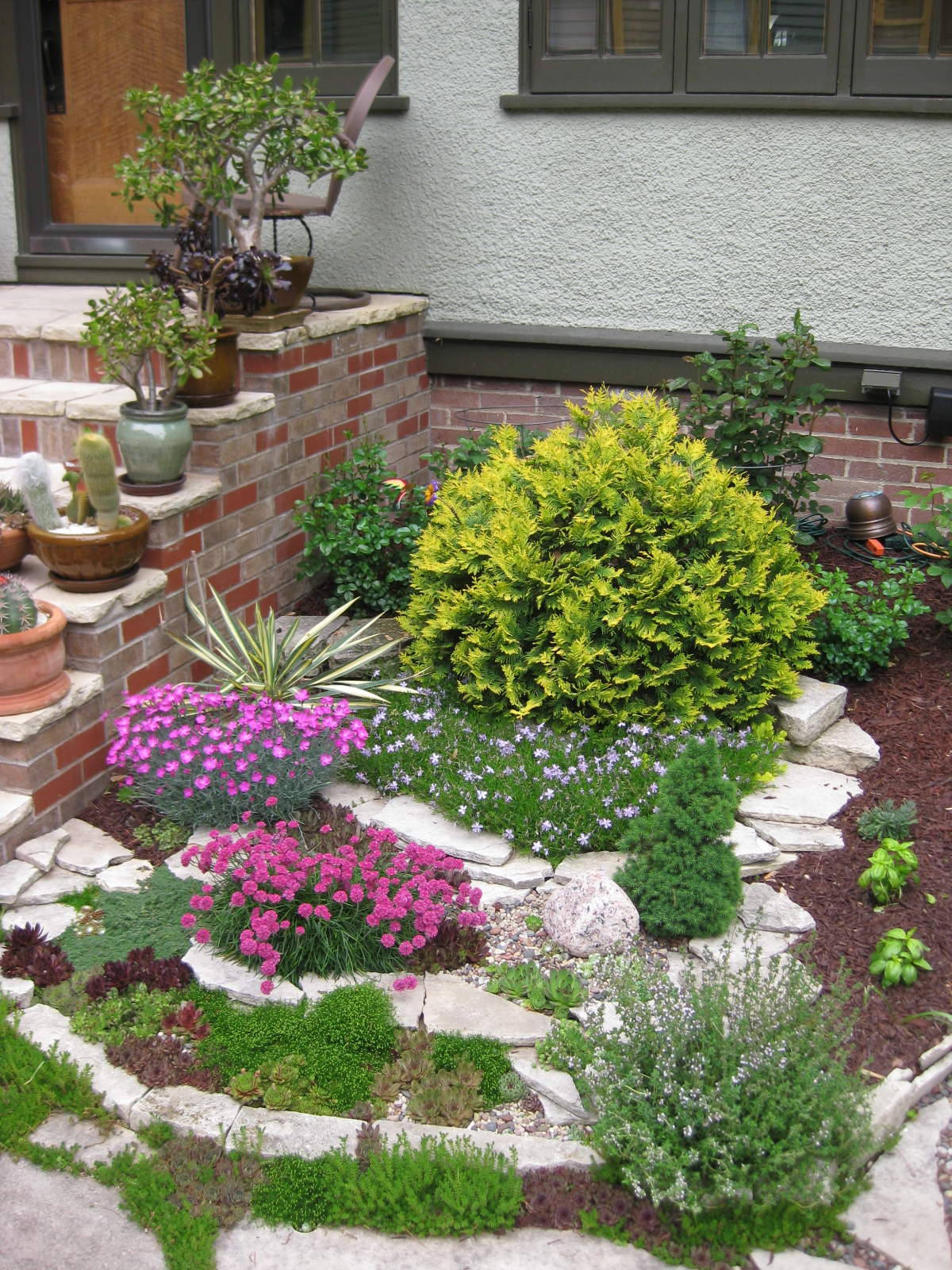
Roses in the back, Golden Globe Arbor Vitae, Yucca, Creeping Phlox, Pinks, Thyme, Basil, Tri-color Sage, Alpine Ground Cover, Irish Moss, and 16 types of Hen and Chicks!

Limestone slabs were used to make the terraces, and rubber mulch or pea gravel was used throughout. Every plant I used can put up with a wide range of temperature and moisture conditions and tolerate hard direct light for several hours a day without harm. They can also manage the dreadful heat generated in this southeast corner. The roses love it here, as they are not winter hardy and the soil by the house stays warm enough to keep the roots from freezing, especially with the rubber mulch four inches deep on top. The Irish Moss seemed fine at first, then seemingly died after blooming, only to suddenly return at multiple sites around the original planting spot from seed. The new plants have proven to be indestructible even though the parent plant didn’t make it. I’ve always had trouble with Irish Moss as it doesn’t follow directions very well or adhere to it’s supposed “ideal” planting instructions, so don’t be shocked if you plant it and it thrives, and then vanishes only to return from seed all over the place. As for the hens-and-chicks, I give them away by the bucket. The Alpine ground cover is pretty neat, growing only an inch high but spreading rapidly; the only problem is it wants to cover all the hens-and-chicks like kudzu; I have to take a scissor to it periodically to teach it a lesson. The phlox, of course, is gorgeous in May and tough as nails. Lavender also does well in this spot, though its growth habit is a little sloppy for this tiny area.
An interesting fact is that the various ground covers and hens-and-chicks maintain their color throughout the winter under the leaves and snow. In fact, some of the hens-and-chicks really take on their most intense color in the cold, late in the fall. So, this little garden provides a lot of interest all the time. In August the roses are six feet tall in the back with gorgeous blooms!
So, that’s what I know. I fiddled around with this spot a lot and must have moved plants in and out fifty times before it had any semblance of the little garden I had in my mind’s eye the whole time. I hate to admit it, but the process actually seemed more fun than the end result; it’s like a little artist’s palette – the fun is in the mixing of the paint.

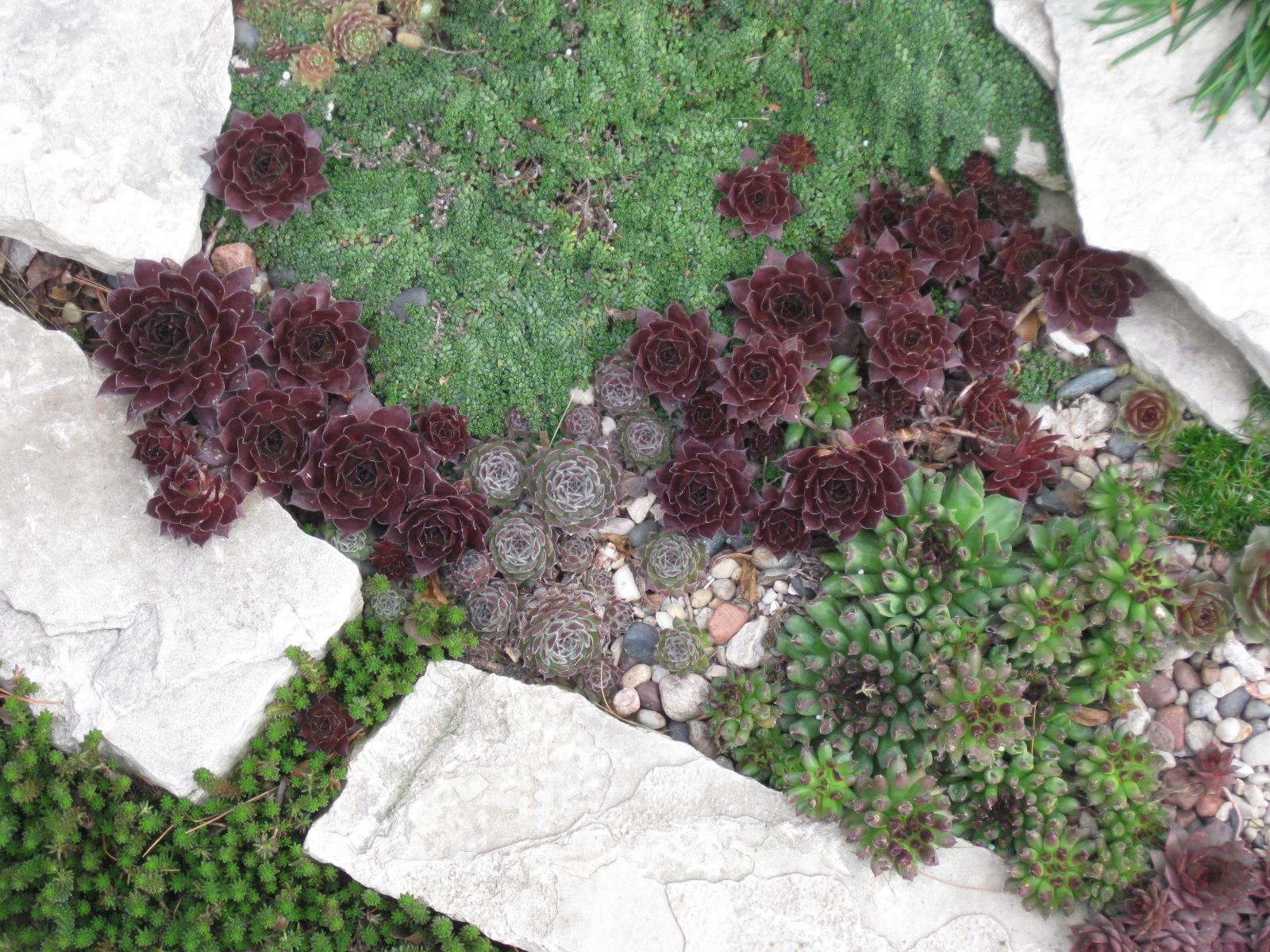
Old Hen and Chicks, Alpine Ground Cover, tiny Sedum…
One wouldn’t think it should be particularly difficult to create and maintain a beautiful garden in the upper Midwest, but one would be wrong. It IS difficult. What plants can tolerate temperature extremes from -27F to 105F? Bone chilling cold, ice, wet snow, fog, high winds, thunderstorms, torrential rains, and unbelievable summer humidity, blazing sun – you just never know what you’re going to get with the weather up here.
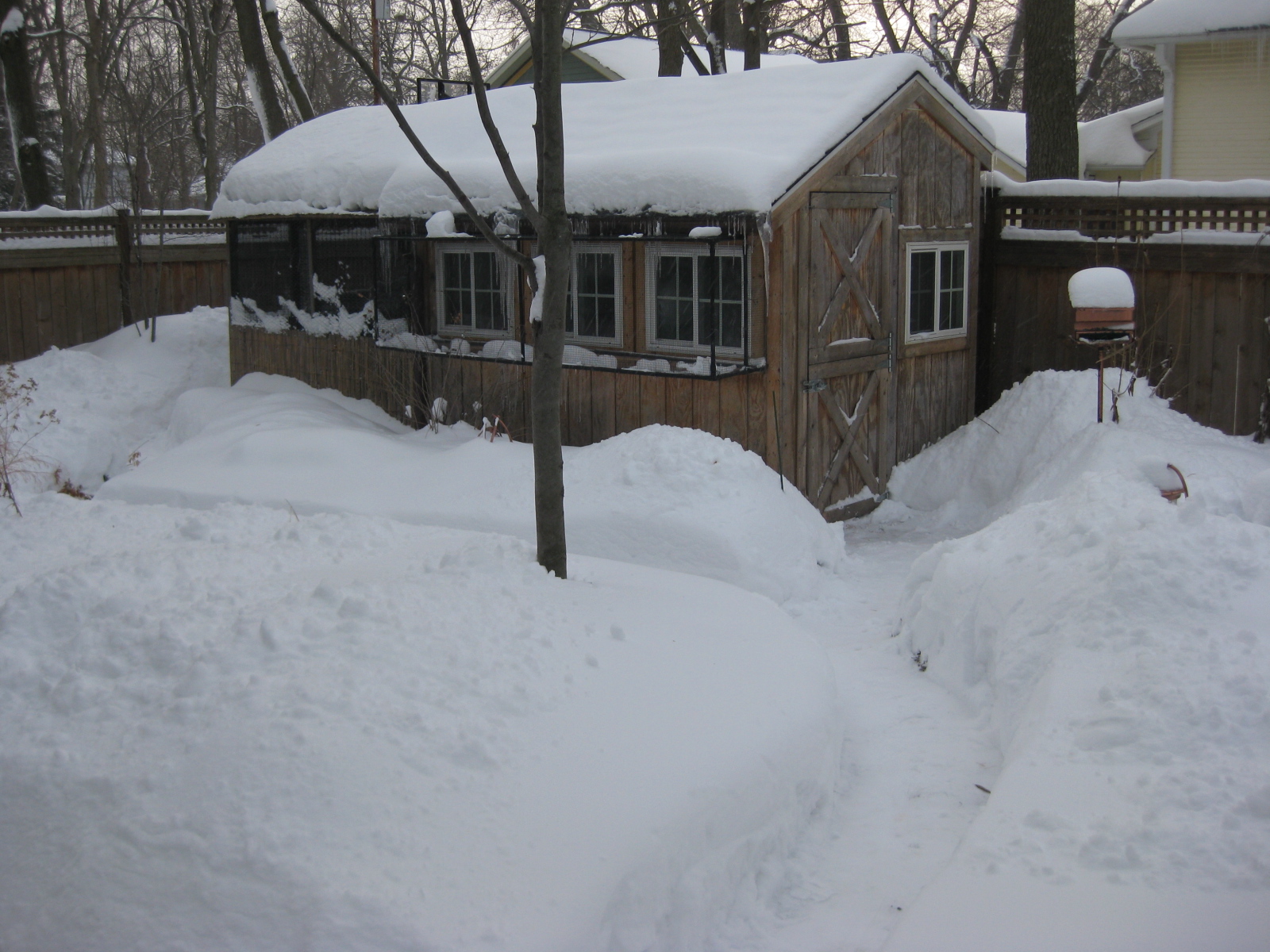
Sometimes it just snows and snows in Iowa. It’s beautiful too, and I love it.
Prairie flowers are tough and beautiful, and they just don’t care about difficult weather conditions. And Iowa’s woodland flowers are just as tough, provided they have a woodland environment and aren’t foolishly planted in the hot blazing sun. But what of the others, the exotics, the domestics, the unusual cultivars, the Tropicals? Well, they can also be grown here as long as they have a wintering place inside. In the summer I have Spanish Moss out back, along with bromeliads of several types, begonias, Wandering Jew, passionflower, Mandeville vine, hibiscus, and even a banana tree. In fact, I have a gigantic Elephant Ear taro that comes up every year beside my goldfish pond; the top freezes out but the roots manage to survive underground on the south side of the house adjacent to the goldfish pond, which I heat and cover for the winter. These Tropicals absolutely love the humidity, heat, and rain of Iowa’s summers and can really thrive if thoughtfully placed. Sometimes I plunk them right into the garden soil, other times I leave them in the pot and bury the pot, and for those I really want to keep, a big ceramic pot holds them in a place of honor somewhere mixed in with the coneflowers, bergamot, lilies, hostas, hybrid rhododendrons, and all the other things that just live no matter what. I’ve been occasionally bemused by the survival of geraniums and annual salvia, buried by the fall leaves and a thick coat of snow for insulation, new leaves poking out tentatively in May from what I thought was a dead stem. So, you just never know. And I sometimes wonder, for those plants which flower and go to seed in my garden, could there be a chance mutation or adaptation that allows the offspring to somehow be more resistant to adverse weather conditions? Every spring hundreds of Impatiens come up all over the garden from seed wintered over from last year’s annuals – they’re tougher than you might think.
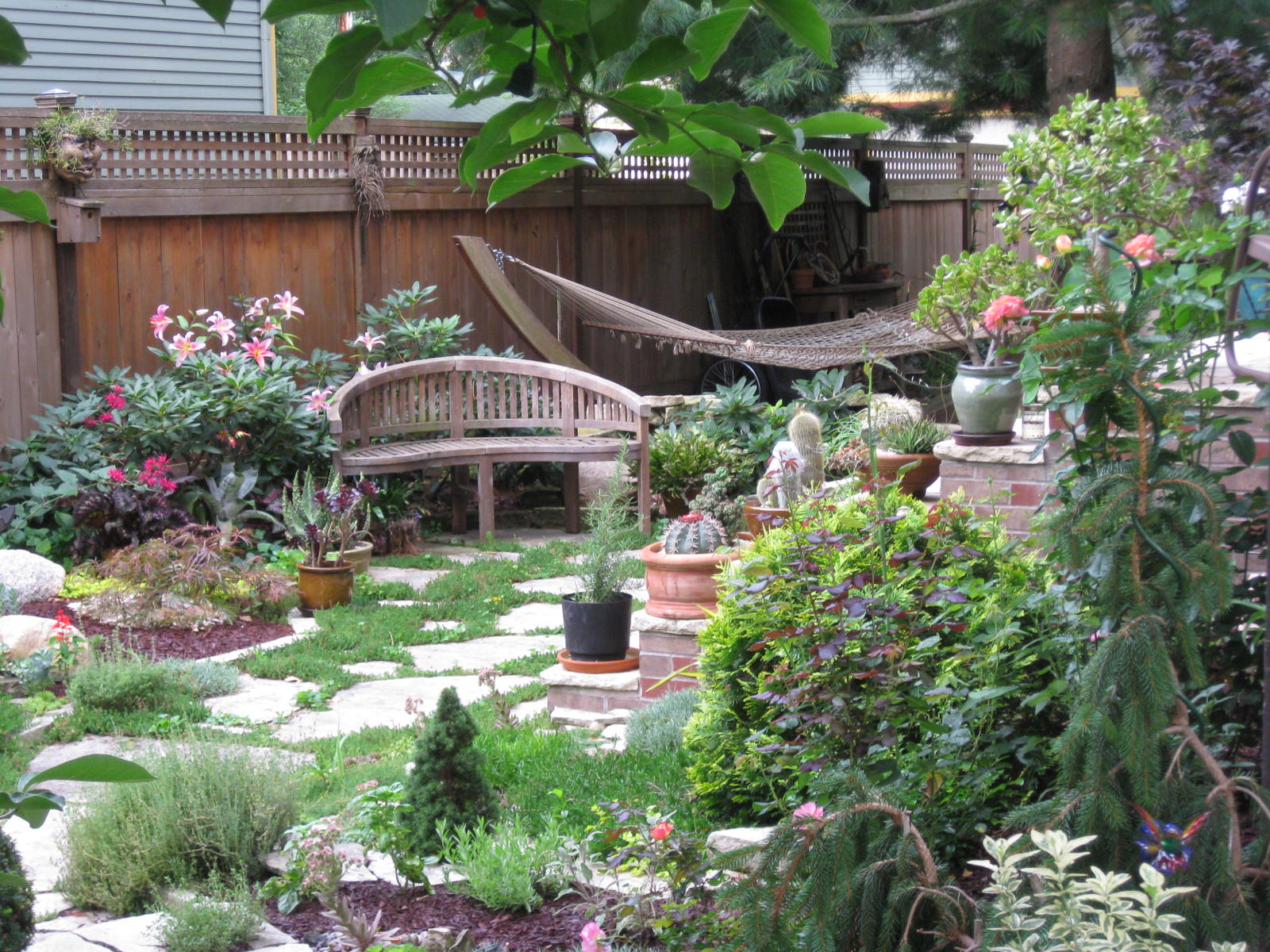
A carefully tended Iowa garden in July.
A couple of years ago I went to the Chelsea Flower Show in London, something I had always wanted to do. The show was amazing, as the Brits DO like their flowers, and the most amazing garden we saw was a Purple Garden. The designer picked only plants and trees with purple coloration, like Purple Beech, Purple Smoke Bush, and Purple Weeping Birch, and then filled in with all sorts of annuals and perennials of various purple shades underneath.
So, we decided to make one in our small back yard when we got home, knowing that it would take a lot of thought. We picked a small area off the patio where we placed as the main focus a Copper Beech tree – a lighter toned version of the Purple Beech. One doesn’t see many Beech trees in Iowa, but they do perfectly well here. Coleus was added, along with some varieties of New Guinea Impatiens. A clump of Little Blue Stem grass added more blue contrast, along with Purple Fountain Grass, Wandering Jew, some Begonia hybrids, Black Taro, and Coral Bells. We found a Purple Joe Pye Weed that proved to be not so purple, so had to get rid of it. Eventually we found a “black” Elderberry bush which has proven to be perfect, along with an annual purple Basil which self-seeds all over the place, and purple sweet potato vines. In the Fall I placed various bulbs to get early color, as The Purple Garden tends to mature in mid July.
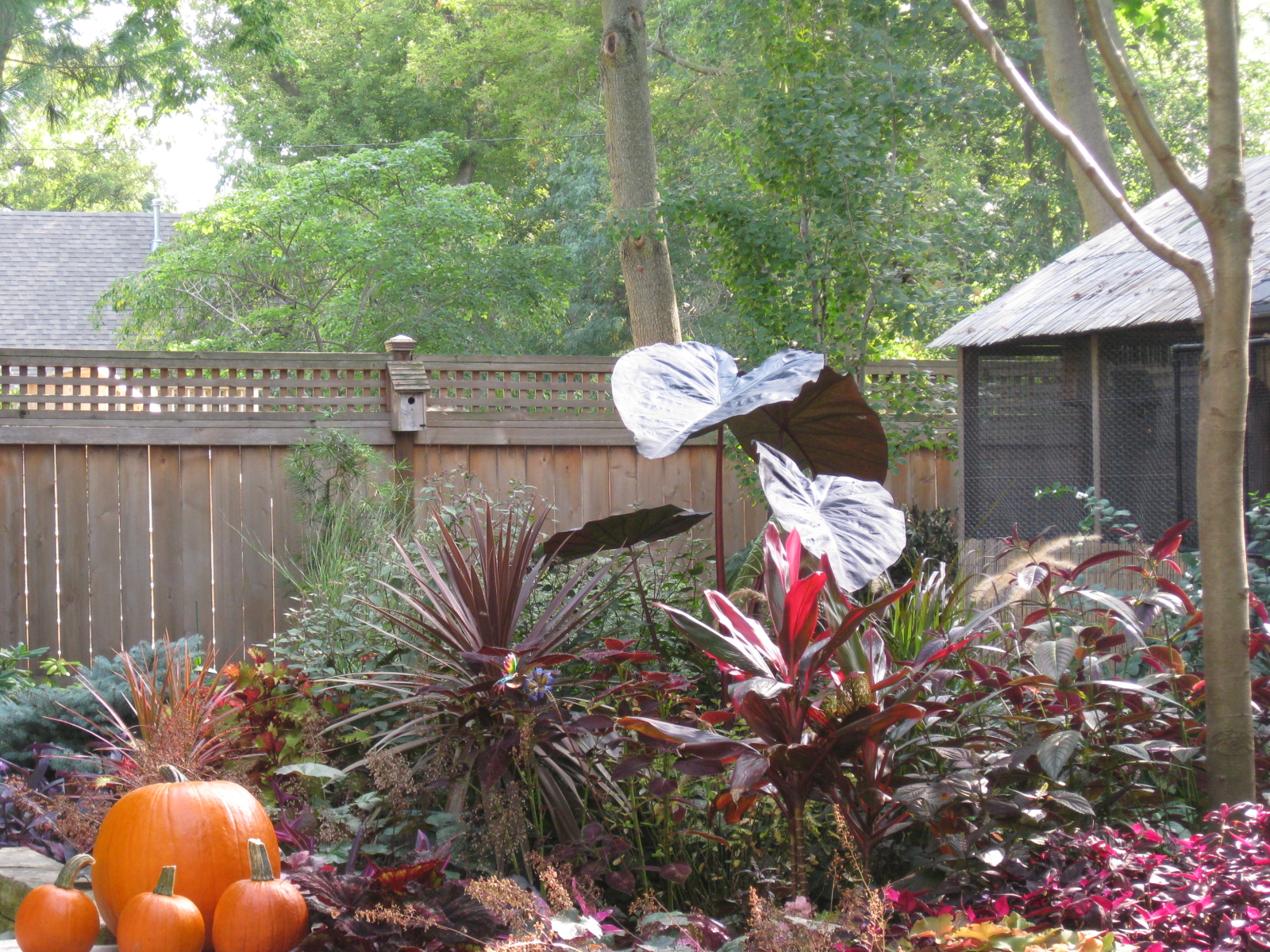
The Purple Garden, September 2009. With pumpkins added.
Every year The Purple Garden is different, and every year it is the last thing to really catch the eye, but it adds tremendous interest and depth to what would otherwise be a much less interesting sea of green in the typical mid-summer Iowa garden, blooming Coneflowers, Black-Eyed Susans, Bee Balm, and Phlox notwithstanding!
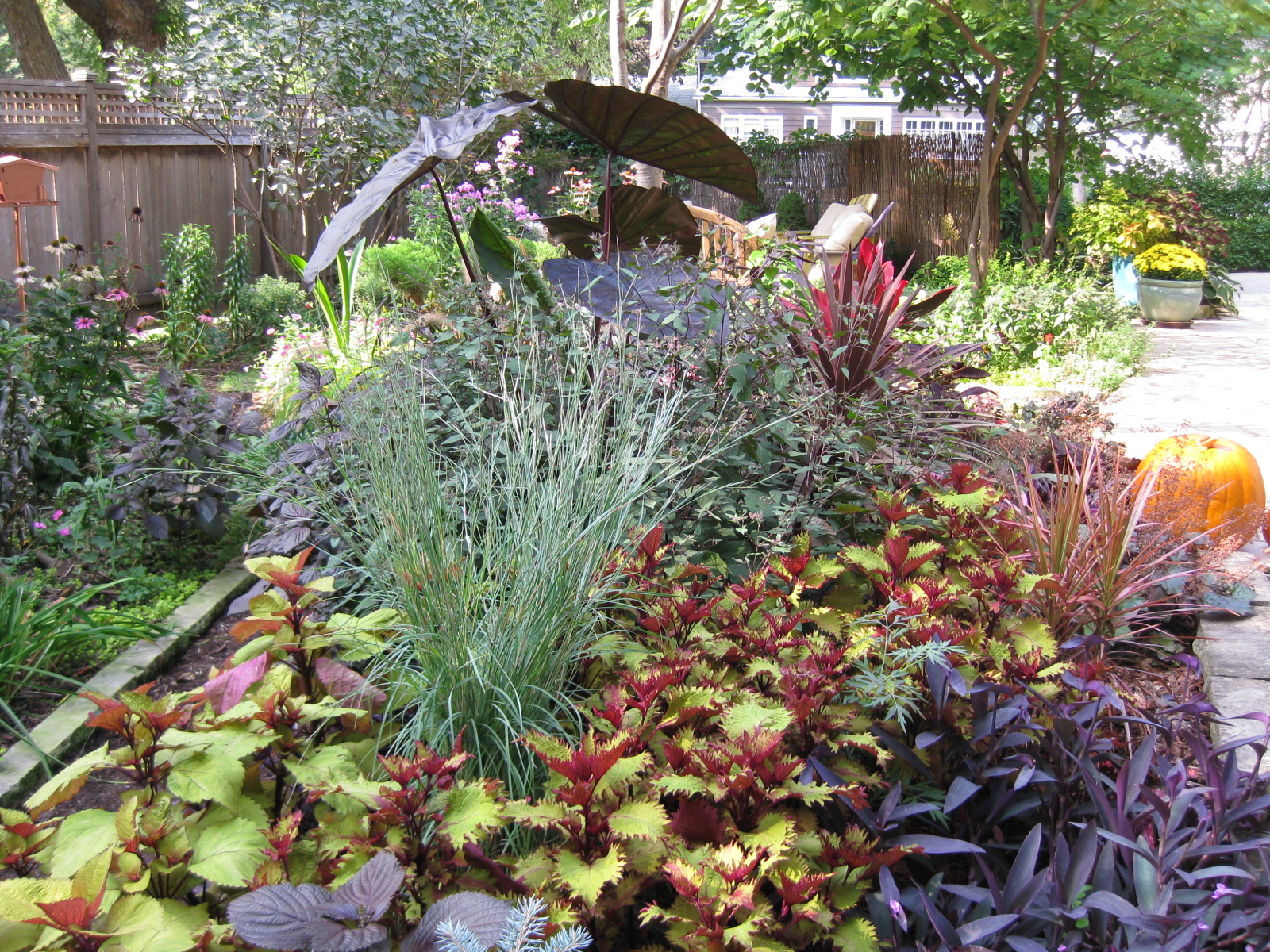
A different view of The Purple Garden. The coleus are beautiful, though the purple undersides of the leaves show only when they flutter in a breeze.
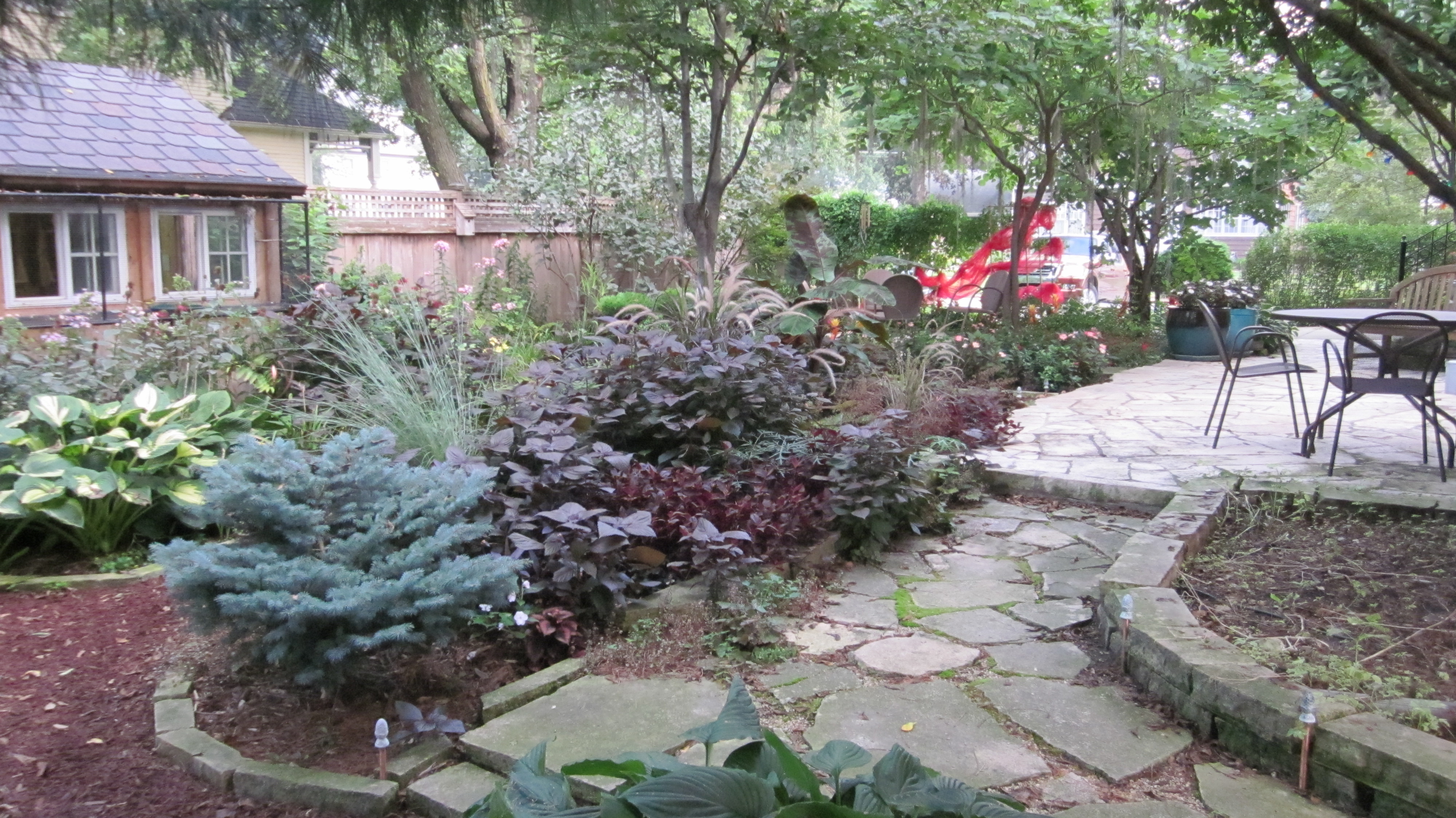
Here’s the 2010 version of the purple garden.
I think the reason the purple garden works so well is that purple foliage creates such a fantastic backdrop or foreground for other things going on in the garden. Try it sometime and think of it as an ever-changing piece of artwork. It’s a great palette upon which to experiment and be creative. In 2011 I’ll be doing away with it though, because I’m now tired of it. I always have to change it up. I will have patches of purple in various places in the background, along with tons of tulips. The Purple Garden will be, I think, a sea of red Salvia and wandering Jew instead.
-
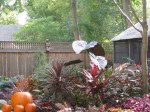
- The Purple Garden, September 2009. With pumpkins added.
-
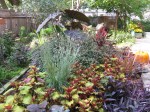
- A different view of The Purple Garden. The coleus were beautiful, though the purple undersides of the leaves showed only when they fluttered in a breeze.
-

- A carefully tended Iowa garden in July.

-

- Sometimes it just snows and snows in Iowa. It’s beautiful too, and I love it.

-

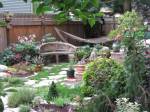
- Here’s the 2010 version of the purple garden.



Now, here’s another cool idea I came up with in the summer of 2010. It all started with my son’s wedding in the back garden, and I was trying to find a way to separate the driveway from the patio where the ceremony would occur. I had already planted an Autumn Clematis on the main fence, then added some trellises for them to climb over to, but they didn’t provide quite enough screening effect to suit me by the time the wedding was about to happen. So, I asked the florist to find a red synthetic gossamer fabric that would be light and inexpensive and resist the effects of rain and sun; she just happened to have such a thing on hand. I wove it through the trellis with her help and trailed it on through the Impatiens in the garden, and now look at this! It is really beautiful, and a marvelous idea for all summer. I will try it again next year with a different color of fabric. It is a neat and easy idea to apply anyplace you need a splash of color and/or some privacy!
Another interesting idea is a poison garden. It’s really a medicinal or herbal garden, but it COULD be a poison garden – a veritable witch’s brew! There is a great book called Wicked Plants that is a must for those interested in what sorts of plants contain harmful compounds. Most of these compounds were the original sources of a number of modern-day medications used regularly in hospitals and pharmacies today. The problem is, of course, that any unsuspecting person can accidentally poison themselves with such plants. The funny thing is that as I read the book, I realized that nearly EVERYTHING in my ornamental garden was already poisonous! The Rhododendrons, Azaleas, and Daphne are particularly dangerous, along with the Digitalis, all parts of the Lilies, and the Tulip Bulbs, for starters. And it gets worse! Monkshood, a very common flower in Iowa gardens is terribly dangerous, as is Castor Bean and Trumpet Flower (a form of the Jimson Weed). Anyway, you get the idea. It’s not a bad idea to know these things.
{To learn all about my rare pigeon breed called Seraphim, go to http://www.seraphimclubinternational.com. This breed is one of the rarest in the world and is alarmingly beautiful. It is bred and raised as a show bird – you will never see one in the wild.}
So, the breeding program I set up last fall has been successful enough to allow me to work almost exclusively with pure Seraphim.
I paired Seahorse up with a daughter of Superjock and Gorgeous (whom I’ve named “Snow”), who is just now old enough to breed. The only show fault I can detect in Seahorse is a little too much downward curve of the beak, and Snow seems perfect to me except she has not quite enough downward beak curve. These two are beautifully matched and make a dashing couple. I caged them the weekend of February 5th in order to enhance their attachment to one another, and by the 18th they had their first egg, which proved to be a dud; by the end of March though they had a new set.
(Update: As of June 1st: two beautiful babies out of the nest, Snow on a new set of eggs.)

Seahorse in front; Snow behind. A beautiful pair.
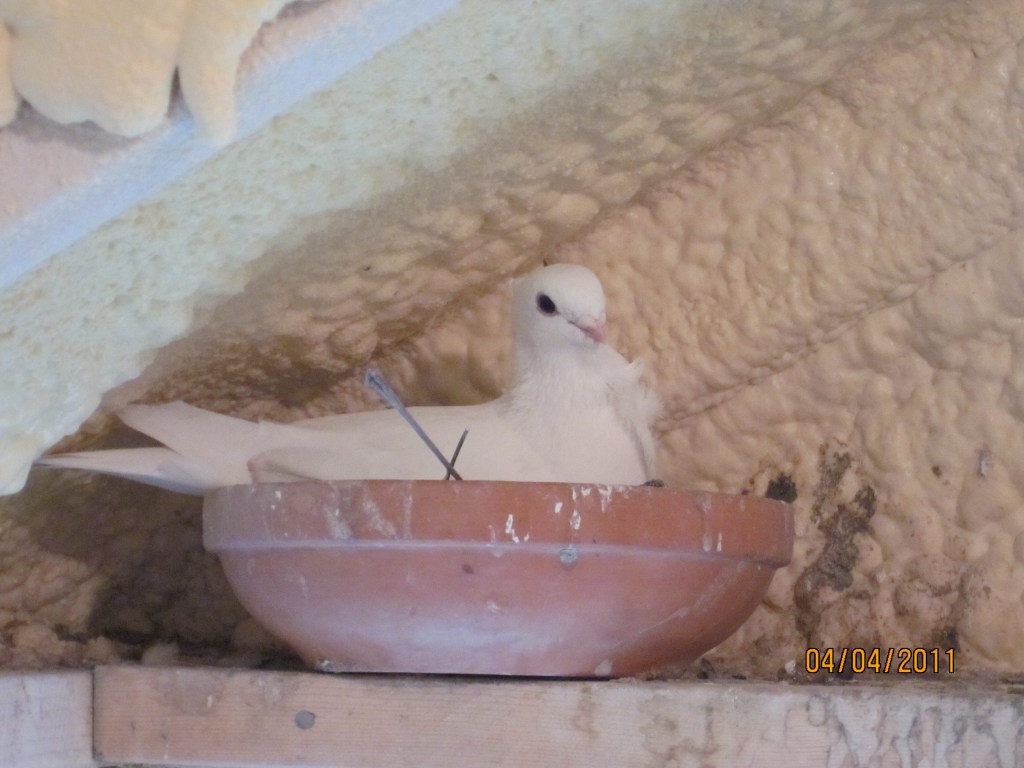
Snow on her first set of eggs, April 4, 2011!
James is now paired with a daughter of Seahorse and Mama, whom I’ve named “Sassy.” James is a large bird, and Sassy is quite delicate. I’m hoping to see a little more delicacy in the offspring from the mother’s genetic contribution, though frankly I am hard-pressed to find any flaws at all in James. He is a stunning Seraph cock. Sassy has a single significant flaw, and that is an imperfect peak; hopefully this will not transmit to many young. She’s otherwise perfect. The unusual thing about this pairing is that these two birds are perhaps even closer than siblings genetically. James is the brother of Seahorse, and Sassy has the same mother as both James and Seahorse. I expect good things from these two.

James on the left, and Sassy, his new mate. They are truly as white as snow. A really beautiful pair.
Superjock and Gorgeous are a great pair, and I’m willing to keep them together even though just 50% of their young are Seraphim. Snow is their first Seraph daughter. They are the first so far to produce another Seraph this year, and it looks like it’s going to be a really nice one – see baby pictures below! He hatched the first part of March, and his name is Gianthead.
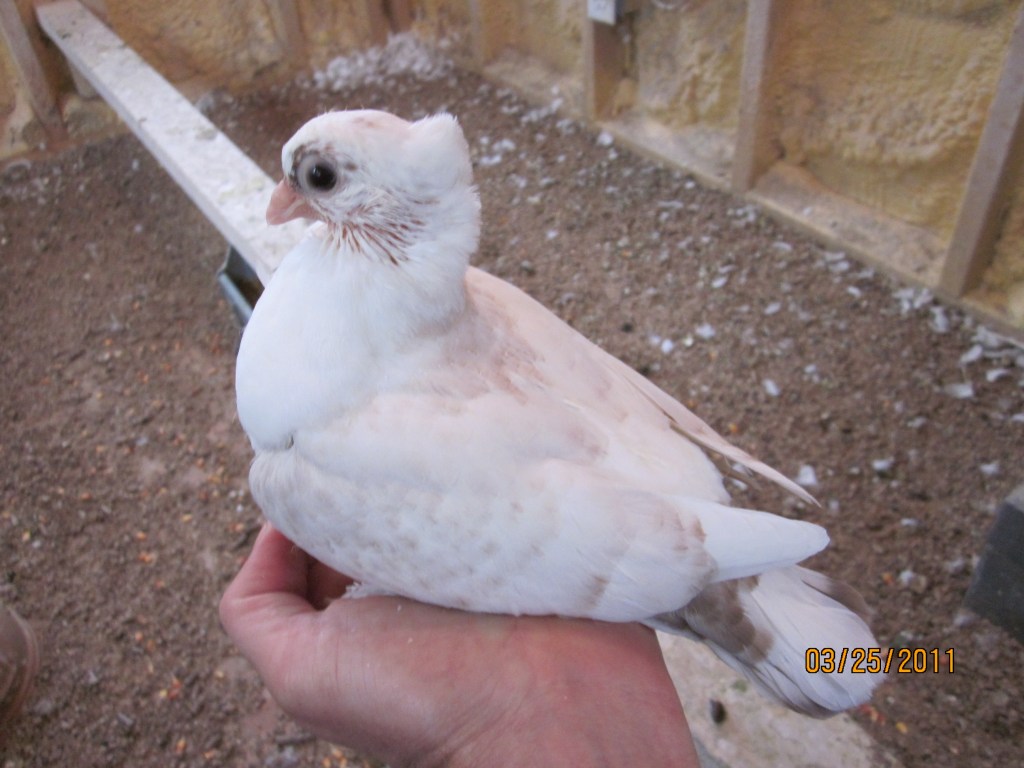
The first Seraph of 2011, just 3 weeks old but already with nice form! Note the reddish coloring that will vanish with the first molt. This little guy is the son of Gorgeous and Superjock; I say “guy” because he is a very aggressive little thing and I think his behavior indicates a male. Isn’t he cute?
 Coz
Coz 