

I am, I think, an extroverted introvert, a person who lives in an internal quiet space but who has to get out on the town now and then, only to withdraw immediately after to rejuvenate. My personality inventories, Beck’s and The Keirsey Temperament Sorter, say I am a Rational INTJ – a pragmatic, idealistic, artisan guard – a Mastermind; introverted, intuitive, thinking, judging. A rare personality, a natural leader who doesn’t want to lead, but who falls into it when others fail to take the lead. Strong-willed, confident and courageous, but yet riddled with pangs of uncertainty.
As an introvert, I have an exhibitionist streak that is hard to explain, along with a self-conscious backlash of insecurity about what I’m exhibiting, an insecurity that gets in the way. I’m happiest in the background, but I need to be in the foreground, even though it makes me super uncomfortable. This has always been the tension I’ve lived with, my Gemini mirror image personality traits.
With singing, I’d rather be in the choir than be the soloist. But if tapped, I will be the soloist. But once doing it, standing out from the group, I’m suddenly smitten with anxiety that my performance isn’t good enough for all those eyes on me. What are they thinking? I tighten up. But it’s not just singing. With any public performance, it’s hard for me to perform individually. Thus, my reticence when asked to lead big projects, to expose myself. What if people think I’m ho-hum. I’m happy to participate and advise and use my expertise behind the scenes, but not so happy to stand out front where my performance can be publicly dissected. With practice and age, I learned how to hide the performance anxiety, but it never left. I appear cool, calm, and collected when giving a talk or chairing a committee; I know that I know what I am doing, but the anxiety remains.
In the privacy of my living room, alone, I can stand out front unabashedly. I can sing at the top of my lungs, and dance, and imagine I had taken a different path in life. I can let my hair down and sing and move without that feeling of tension. And it shows. My body is loose, my voice is resonant, and I can do things with it I could never do while being observed by a crowd. Here, I can be Steven Tyler, or George Michael, or Axel Rose, or Elton John, or Adam Lambert. I can let out the lead singer in me, the unfettered exhibitionist.
I once had a great voice, a high tenor that could flip into falsetto with ease, a requirement for the ’80s lead singers in groups like Queen, Journey, REO Speedwagon, the Eagles, and so on. I was in choir and swing choir in school. I was often a soloist. I sang in church and in competitions, in duets and trios and quartets. I sang in a lot of weddings. Sing, sing, sing! That’s all I wanted to do! Singing with ABBA on the radio with my cousin Susan in the pickup after walking beans was a highlight of my life I’ll never forget. Susan was hilarious as an ABBA singer.
A lot of my skill with finding harmonies came from singing gospel in our local church, a church that had a bizarre number of exceptionally good singers. And White! Who would have thought. The rest came from working with Tom Oliver, our music teacher at the high school. He was great. He directed us for the annual music competitions, arranged all of our concerts, and choreographed all of the high school musicals. And built all the sets! What a remarkable guy.
What I really wanted to be in life was the lead singer in a popular band that travelled the world. The voice, the tight leather pants, the hair, the scene, the adoring crowd – that’s what I wanted. I was stung by the fact I seemed to have no natural inclination for an instrument, however. I played trumpet and euphonium in band. I talked my dad into buying me a bass guitar. I eventually was sort of okay on it, but it was a struggle, like learning piano. I think I have a connection missing between the musical part of my brain and my fingers. All the lead singers I knew of also played a guitar, or drums, or electric piano. I needed to up my game.
My best friend in college, Doug Seifert, was a remarkable guitar player. He loved AC/DC, Molly Hatchet, and other heavy metal groups. We played together quite a bit, and decided to make a little band, along with our friend Victor Davis, the drummer, and try out for the college Spring Fling, an expose’ of hidden student talent that performed every spring. The judges for the show at our Christian college, however, didn’t like Molly Hatchet’s “Bounty Hunter” too much, especially the lyric “I just got back from a trip to hell,” and especially when Doug started wiggling his tongue around like Gene Simmons in KISS. They stopped us almost before we started! “You will NOT be performing THAT at a Christian college! Now go get a haircut, all of you!” I flipped my shoulder length platinum blonde mane and stalked out.
When I was a kid, my sister Mary Ann really wanted to be a ballet dancer. Mom enrolled her in Sondra Cox’s dance academy in Oskaloosa, Iowa, as Mary Ann was really serious about it. Sondra needed more boys in class, though, so she talked Mom into enrolling my brother, Neal, and me as well. I was thrilled, but not Neal! He was furious. But he was also a natural athlete, so in spite of his efforts to ruin his own experience in ballet and tap, he still excelled. I, however, was crippled by embarrassment when told to perform a bit of dance choreography in the group; my introverted side took over, and I would freeze up. The steps I had learned suddenly became unreachable. The dance recital that first year was a terror! I got through it, but not without my mind leaving my body during the performance. Lots of mistakes. But when it was over, I was thrilled. I loved being on the stage. I just didn’t want anyone to look at me. I guess I thought I just couldn’t do it. I wasn’t good enough. At the end of the year, Neal insisted on un-enrolling. I agreed to another year with Mary Ann. However, a terrible thing happened. Our dance teacher was killed in a terrible traffic accident. And that was the end of that. The next time I took dance was at age twenty-seven at the Vallair ballroom in Des Moines with my wife, bigly pregnant with our second son. In a crowd, ballroom dancing was easier for me, and I didn’t get so self-conscious doing it. We had a lot of fun dancing socially for years after that. The next time I took dance lessons was at age thirty-eight with Teresa Heiland, Ph.D., at Grinnell College. Now with age and better understanding of myself, I was able to learn Modern, Ballet, and Rumba and perform it on stage without losing my cool.
It was about that time when I went to see the Broadway musical “Chicago” in Chicago. The show was fabulous. The singing! The performing! And the dancing! The dance, Modern, was choreographed by Bob Fosse with his inimitable style. The performers were gorgeous. Oh! I LOVED it! At some point, watching the dancers, I was filled with emotion. I want to do THAT! I had the sudden realization that this pipedream of mine of being a stage performer was never going to happen. Not lead singer, not dancer, none of it. I was a surgeon by then, a much more pragmatic and sensible career path. A safer choice for me. But when thinking about that choice now, I realize the operating room turned out to be my little stage, the place where I could be front and center without anxiety, a place where my exceptional performance skills could be seen. Here, with a small audience, the extrovert in me could take over and really show what I could do.
Later, in my early forties I would occasionally go to a dance club with my husband. Then, this was the place to be seen, and since it was a crowd where I didn’t have to be alone out front, I could perform with abandon. In New York City we were the first out on the dance floor, engaging the surrounding crowd with our Bob Fosse moves and pelvic gyrations until they all jumped onto the floor with us. At The Garden in Des Moines, we made such a scene in the crowd on the dance floor that the manager asked us to perform on stage at midnight for the Mr. Buns Contest. My husband readily agreed before I could say no, but when I found out the crowd would expect to actually SEE those buns, we bailed. “I’m the chairman of a surgery department, Kevin! Good god! News of this will get back to Grinnell before we do!” Like Cinderella at the ball, we ran to the car and drove away before midnight. Meanwhile, we were told, the crowd was chanting for David and Kevin, David and Kevin, but finally had to give up in despair. My one chance and I blew it. I would have won. Years later, I learned that my bubble butt was a regular source of conversation at the hospital. I guess it looked particularly nice draped in scrubs. When visiting my buddy, Dr. Stewert, who was our anesthesiologist for many years, he whipped out a picture book he had been given when he left our hospital. It was full of random photos of him and the staff from his sojourn there, with very funny comments. One photo leaped out; a picture of Stewie and me scrubbing together at the sink, his ass labelled “dark chocolate,” and mine labelled “white chocolate.” Stewie was Black. Still is, in fact. He was particularly amused by this picture, and he was the one who told me that our butts were a constant source of conversation. I pretended to be shocked.
I guess I was so comfortable being the surgeon in a small-town hospital because, well, it was small. There I could perform out front without being overwhelmed by too many eyes. I made forays into the bigger scenes in the cities and Universities, giving lectures and writing papers, but it was always such a relief to get in the car and retreat to home where I belonged. In a way, I lost my little audience when I retired, my town, my hospital, my department, my clinic, the people – or so I thought. But it turns out I can write, and I can tell stories. People who are interested can see me through the written word while I remain hidden. Perfect! Best of both worlds! And I can SING in the living room! And I can dance there without restriction, without choreography – at least as well as this older beat-up body will allow me to! And I can be a grandpa with a manageable audience of just two sets of eyes, perhaps the best star role of my life.
And my butt still looks great, even if no one at The Garden ever gets to see it.
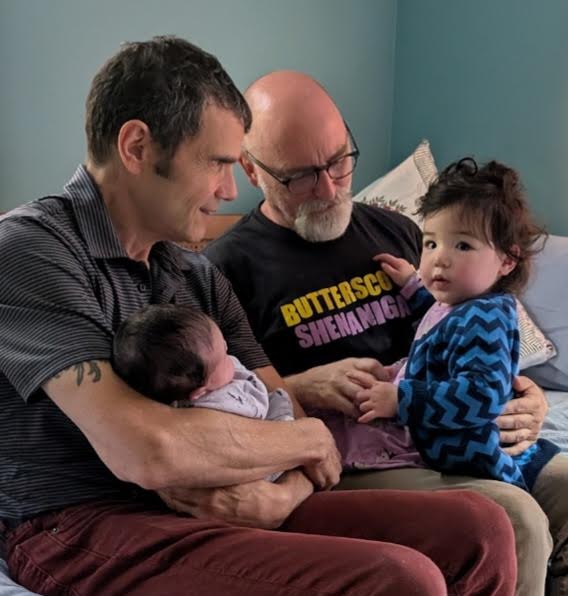
It seems that just the other day I was forty, the father of three teenagers, and just starting over after the end of an eighteen-year marriage. We have regular situations in life which cause us to start life anew, to reassess and change course and alter our view of the world. For me, they were: going off to kindergarten, entering high school, college, marriage, fatherhood, starting a career, end of marriage, new relationship, traveling to other countries, unexpected health problems, kids off to college, retirement, and now grand- fatherhood. Each of these periods opened with a new big situation that required learning and rethinking my existence; each one seems like a sort of life era from this vantage point. I’m old enough now to see my own life story as it has played out. Each of the big changes was fraught with stress and difficulty at first, followed by a gradual peaceful normality. Sometimes I thought I wouldn’t get through; it was just too hard. But I always did. And later in life I realized that no matter how difficult the situation I have ever been in, it has always resolved to a tolerable level of stress within a few weeks and resolved within a few months one way or another. That knowledge does not, however, keep me from being anxiety ridden every time something big and new comes up, but it does give me some valuable perspective. Every difficulty will pass.
I don’t think it’s true that what doesn’t kill you makes you stronger. You just end up the same or a bit weaker while carrying a heavier emotional load. I mean, sure, you might be wiser, and you might look stronger to outside observers since you can carry so much, you might not have bent, but it gets harder to trudge along the trail of life carrying the baggage from so many battles. You just get more tired from the burden of life. At first, as youngsters, we spring along like little antelopes. Everything is new and hopeful. By 65, meh, not so much. Things get heavy. It doesn’t seem like one should wake up each day wondering how much longer they will live rather than leaping out of bed wondering what the new day will bring.
It is strange to feel emotionally and intellectually forty when looking in the mirror but seeing a much older person looking back at you. Who is that, I wonder sometimes. Whenever I go to an event where the crowd is older, like the symphony, I find myself studying the people and thinking to myself who ARE all these ancient people. It never occurs to me that any of them are wondering the same thing about me. I see older people as if they are a different animal, another species, even though I’m one now. I can’t help it. You can’t tell by looking at them that they were once beautiful and full of vivacity, which is how I still feel. Yes, everything hurts most days, but so what. I have things to do.
I am thankful for mostly good health and an outlook on life that has allowed me to live in a relatively peaceful state in each era. I tend to be happy and content from within. When things have gone wrong with me physically, they’ve mostly been fixable, allowing me to look at how it affects me with some detachment and bemusement. And when not fixable, I just think, okay, this is what I have to work with now. And that’s what I do.
My newest era is being a grandpa. It has taken me a while to embrace the role. I didn’t know how to be one. Still don’t. I think my job is to play and demonstrate a certain reliable solidness to the two little tykes, a solidness they can always look to for comfort when it seems the world is falling apart. And love them, which is surprisingly easy. The role makes me feel lighter, not heavier. It’s a thrill to see the world through the eyes of a toddler again, watching the gears turn and awareness setting in and listening to the sounds of mirth and surprise when something new (which is everything) tickles them in some way. The little brain soaking up everything with astonishing speed, the absolutely flawless skin and physical perfection of youth radiating out like a sunbeam. Life is just better when everything is new and exciting, and partaking of that excitement through the eyes of a little one is perhaps better than one’s own first time around. At least that’s how it seems to me. I loved being a little kid, but I think I love seeing my granddaughters be little kids more.
We pulled up stakes and moved across the country to participate in this particularly important era. We left our friends and the rest of our family, our community, our home, and just drove away to something new. And now, once again, the stress of adjusting, changing our lives, learning new cultural nuance, finding additional friends, learning the ropes of living here, getting a house and making it a home. It’s been a very long time since we had a disruption like this, and I’m still not sure how I feel about it, so close upon the heels of my retirement. I hadn’t quite yet found my legs after retirement when we jumped ship to being grandpas, so the determination of how I will be living my post-retirement life is not yet entirely clear. In spite of the drama and difficulties and uncertainties of the past year, though, I feel invigorated by all the change. I was getting bored before we decided to move. I’m not bored now!
How does a guy stay vibrant at this stage of life? It is true that one feels unseen once the gray appears. There’s a lot to sex appeal in forming friendships and work collaborations and in being noticed socially. It’s as if sexual vitality is the key to every sort of attractiveness, and to being socially visible. I can see it easily from this age, how it matters so much, how the appearance of youth and fertility greases the skids for having a social life. People in the prime of life talk to you and notice you when your hair is still black and your physique still has bounce.
I guess older women notice me now. At the gym I wear a t-shirt that says SISSY in big bold letters. It’s a joke, as I’m not a sissy, and I don’t look like one. It’s fun to wear it. I can see people studying the shirt, and then studying me, trying to figure out what in the world I’m trying to say. I should have put LIVE LIFE IRONICALLY on the shirt, I guess, to make it easier. One day as I walked past a much older woman, she looked at my shirt, looked me up and down, and said with gusto, “Oh, I don’t THINK so!” Good point, I thought. And then, the same week, while lying on my back doing a stretch for my lower back, suddenly another much older woman was standing over me. “Mmmm, do you mind if I ask you about the stretch you are doing? It looks so interesting.” I think she was looking for a different sort of stretching, however. So, I guess I’m still being seen, but now it’s by older women, the same ones that seem like a different sort of human to me.
My husband and I used to travel on occasion, and when we could, we would stay at a gay inn or resort. We were young and vibrant and got lots of attention and social cache from the other men there who typically ranged in age from eighteen to fifty-five or so, the period of life when you’re still youthful enough that it is hard to tell your age for sure. Our handsomeness was, apparently, notable. But the age range over fifty-five was distinctly absent at these places, partly due to the deaths of so many young men from AIDS in the ’80s and ’90s, but also because of the emphasis on relative youth that seems mandatory for such resorts. And now that we are in that absent age range, we find that we are hesitant to stay there anymore. People will think we are old, we think, and the physical signs of our age will be a detriment. No one will talk to us, we think. We don’t KNOW this for sure, but we sort of do. So, to protect our egos, we stay in regular places. I sometimes think this is such an odd perspective for both of us. We are both smart, socially reliable and funny. Why are we so sure we won’t be interesting to all age groups? We are both a bit introverted, so that may be part of it. Reaching out to engage and make new friends seems like a leap too far at times.
Maybe it’s like studying oneself in a mirror; it took me a long time to realize that to really see an older person, you had to dig in. You have to ask them questions, study them. Who were you at eighteen? What did you do? What has your life been like? My goodness, I’ve been surprised out of my wits by some of the things an old dodderer has told me they had done in their lives. Wonderful things, great things! But you don’t know it unless you give them the time of day. You have to assume they have an interesting life, an interesting story to tell, or you don’t bother to engage. Maybe we can fix the problem of not being noticed in old age by taking the time to notice and engage others. It should go both ways, shouldn’t it. Maybe the problem is not the lack of being seen, but rather, making assumptions about not being seen and then withdrawing. I don’t know. Perhaps it’s time to travel more and do some social experiments to find out.
In the meantime, we’re playing with our granddaughters every day and getting our home situated to our liking. With any luck we can live here for twenty years before everything really goes south, so the house and gardens have to be just so, as does the way we live our lives for this last part. This is no time to wear out and wind down! Onward!

It has been a good long while since I’ve written a thing on this blog. At first it was because I became so disillusioned with the news of the world with which I was being bombarded every day. It just seemed like the human populace had lost its collective mind, and what could I possibly say about all of the insanity around me that would matter to anyone anyway?
And then, in the Fall of 2013, in the midst of my aggravation with the world as a whole, a much more pressing personal problem arose when my youngest son, at 23, called to say he hadn’t been feeling well for a few months; just tired and run down at first, but then fevers and night sweats for no apparent reason. I had him make an appointment with an infectious disease doctor who, in a matter of minutes, determined that he had lymphoma, a cancer of the lymph nodes. It was obvious on his physical exam.
I can look back on this past year and a half now with more calm, but only because my son is thankfully still here and was in remission for about a year, giving him and the rest of us a window of opportunity to gain perspective. Now we are back at it again with chemotherapy and a stem cell transplant planned in about six weeks.
When I sat down to write about it, and almost never being at a loss for words, I thought it wouldn’t be difficult, but I determined after pages of prose that I couldn’t properly write about it, or rather that I didn’t really want to share the experience with that degree of intimacy. Everything I put on the page seemed trite, and I realized I simply could not express properly what has happened to him, me, his mother, his brothers, his fiancé, his sisters-in-law, and his “Dad #2” (my husband) in the process of going through this. Oh, I can describe it, but no description seems to accurately capture the feeling of where we have been. It has changed us all, that’s all I know, and everything about it feels too personal to share completely, though some day that may no longer be true. I’ll keep the writing of that story on my “list of things to do” just in case.
January, 2019. Well, this story is definitely due for an update. When I wrote it I didn’t think about the fact that it was a cliffhanger. Sam underwent back-to-back stem cell transplants with chemo and radiation. He was very sick but his doctors at The Siteman Cancer Center at Barnes Jewish Hospital in St. Louis had a trick up their sleeves with a new protocol from Stanford University. And now he’s back to his old self, healthy once again. He married his fiancé in 2016. He and his wife have a very interesting life now in St. Louis where she is an artist, and he is a partner in the game company Butterscotch Shenanigans. We don’t know what life will bring going forward, of course, but we are very grateful.
February, 2024. And now there’s a baby, a little girl. Once again science and technology saved the day with the miracle of in-vitro techniques. I hope this child has a fabulous life.
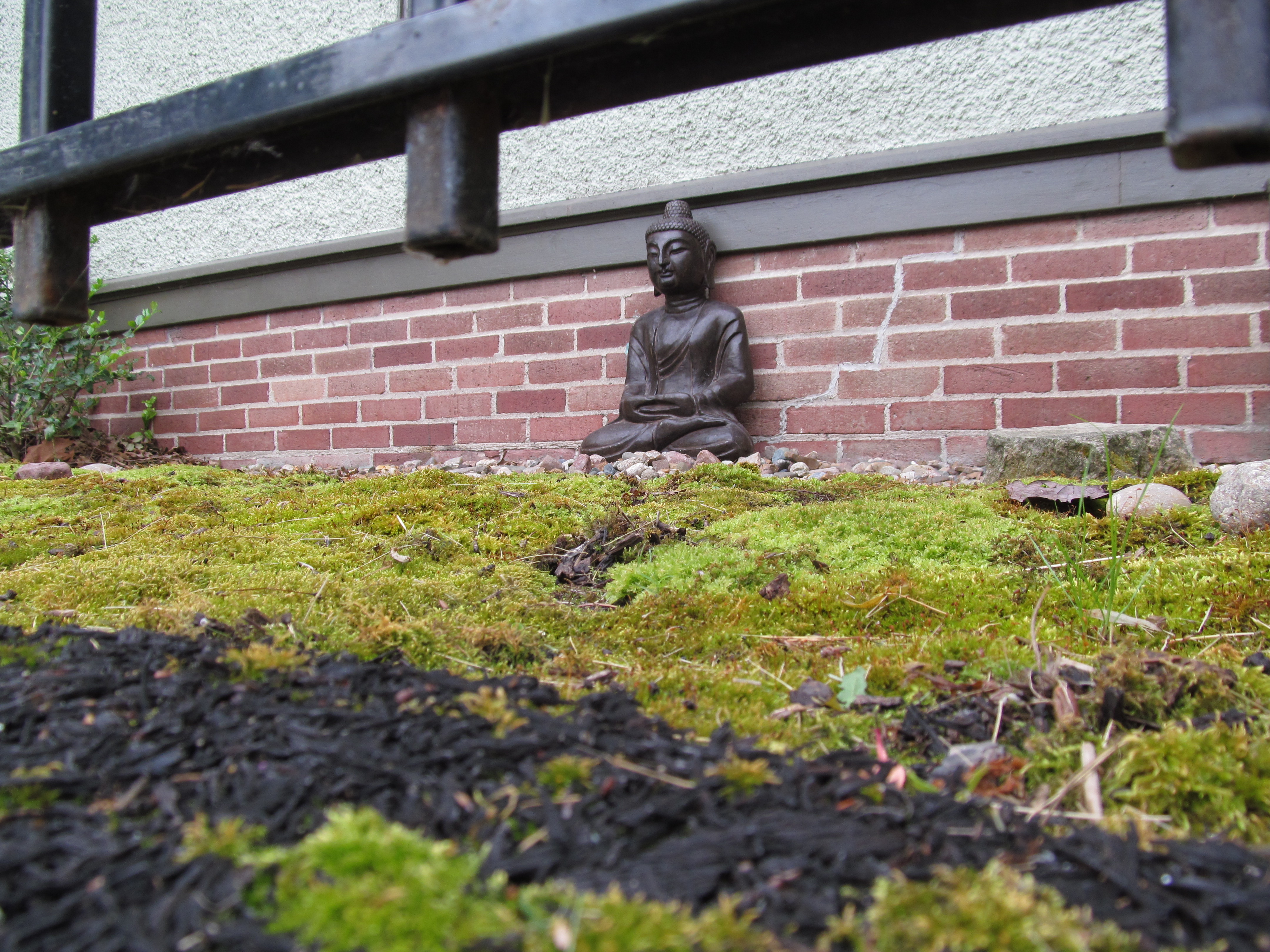
Wait a minute – you mean Japan? No. I mean it’s possible to have a beautiful moss garden in Iowa simply by locating the correct micro-environment. Like the Japanese, we have many opportunities to take advantage of microclimates in our own yards and gardens if we just stop a minute and look around! With a little ingenuity one can make almost any sort of garden in Iowa.
I first saw pictures of moss gardens in exotic books about Japanese gardening, and although I had on occasion stumbled across logs and soil dripping with moss while hunting morels in the spring in the Iowa woods and found big patches of moss growing in the oddest places in town, it just never occurred to me to make the effort to cultivate moss.
Yet I had a very annoying little garden spot on the north side of the house, a narrow little space between the sidewalk and some cut limestone and pebbles by the foundation that was constantly filling up with moss. In fact, I had to fight the moss off! It would grow up over the stems of the Begonias and Impatience I planted there, stunting the poor things. The space always annoyed me, as nothing I did there ever seemed quite right, and the space was sort of an afterthought, the last thing I attended to every year.
So, one day I was in St. Louis and decided to visit the Missouri Botanical Gardens. What a treat! The place is stunning, and any reader who has the opportunity and any interest at all in gardening should go! Water gardens, conservatories, annual beds, exotics, garden sculptures, massive Asian style gardens, herbariums, and more – just a stunning place. There I stumbled upon a moss garden hidden on a peninsula under a copse of little trees overlooking the big pond in the massive Japanese gardens. It was quiet. There was a stone path leading into a little stone hut where one could sit and admire the carpet-like appearance of the moss, with little red crab apples scattered across it, while ducks and Canada Geese landed on the pond. Each person who came in went silent, as if they were in a sanctuary of sorts. It was really not just visually beautiful, but an overall beautifully immersive experience.
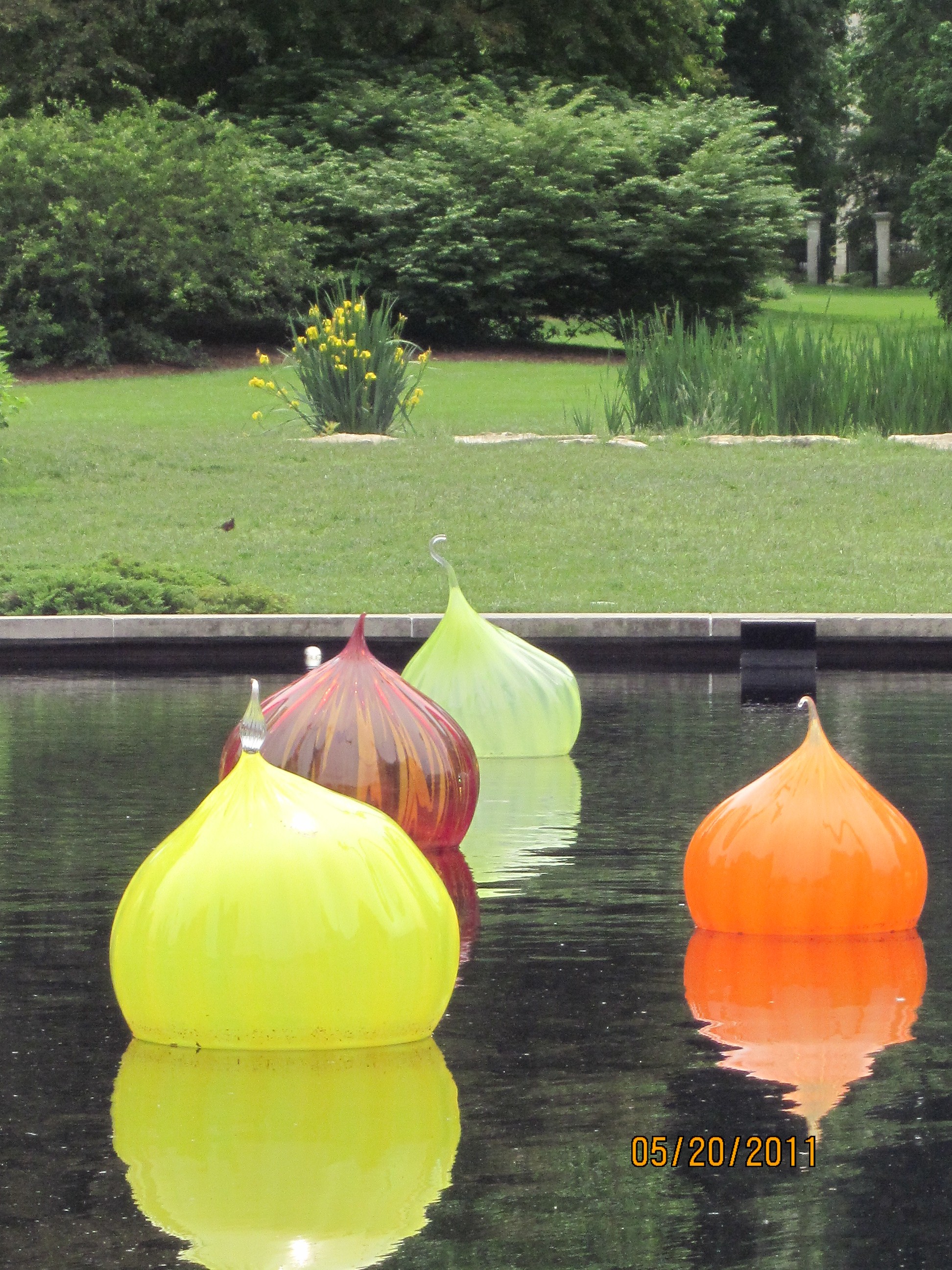
Glass Water Globe Sculptures floating on a pond at the Missouri Botanic Gardens.

A view of the Moss Garden overlooking the pond in the massive Japanese gardens at the Missouri Botanic Gardens in St. Louis. It is covered by a copse of flowering crab apple trees, allowing in dappled light. Nearby is a stone hut where one can sit and meditate. It’s a stunning view.
Home I went, determined to make a moss garden if it was the last thing I ever did. My space for it is not exactly private, located on a public sidewalk, but it’s a very quiet street and a very quiet sidewalk, so it didn’t matter. I turned the soil and raked out the moss that already existed, putting it in a pile. Sticks, leaves, and plant residue was removed and the surface smoothed. The moss was replaced in a patchwork with wide open spaces in-between. Several missions around town and into the woods located patches here and there of several other varieties of moss which were harvested and brought back to be pressed into the soil in various spaces, adding to the patchwork of color and pattern, as each variety was a little different from the next. Then a trip to a different forest for other types, and finally even to an abandoned house where I found some really unusual mosses growing on old boards, shingles, and even curtains. (The roofs had caved in, allowing in rain and just enough light to create an optimal moss environment.) If the moss was adherent to a twig or sliver of wood, I just brought the whole thing. Eventually I obtained at least six different varieties of moss.

A freshly planted moss garden using patches of Moss harvested in town, in the woods, and from abandoned buildings in the area.
Then it was a matter of watering regularly to keep it moist, though Iowa is a pretty wet place and most of the time I had to do nothing. Moss likes a bit of sunlight, not total shade, and this spot had a short period of direct sunlight in the morning and late afternoon, dappled shade for part of the day, and total shade for part of the day – just about perfect. Plus, it was relatively cool compared to other areas around the house. The biggest problem was the squirrels who, for some reason, seemed to want to know what was under each piece of moss, turning them over repeatedly until I wanted to catch each one of them and give it a good thrashing. Eventually they became mostly bored of their tiresome game, but they still poke around in there almost every day doing some sort of bedevilment, the little monsters. The other problem was simply keeping grass clippings and what not off the surface. In order to thrive, moss has to get air and light, so it has to be kept free of detritus. From early Spring until late Fall I attend to this task with a little bowl and a handheld brush with soft bristles, going out every couple of weeks and cleaning it off. In the Fall I just let winter take over; the leaves cover it, or they don’t, I don’t care. By March 1st I uncover it to find bright green happy moss already expanding on the cold ground. It grows a lot during long periods of cold as long as it’s not January and twenty below. The snow on top of it keeps it warm enough to continue to spread under the snow. Moss is tough. In the summer it can dry out completely and appear to be dead, only to revive itself with late fall rains. Aside from the occasional sweeping, it’s not difficult to manage. It gets so thick weeds can hardly get through it.

A nearly mature moss garden.
As a final touch, one can add stones, boulders, statuary, and an occasional tuft of grass or single flowering plant to the patch of Moss for artistic interest. It’s a very simple but beautiful look that causes those strolling by to stop and ponder for a moment – a bit of Zen before walking into the daily insanity of regular life.

Completed moss garden with stone statue, Oklahoma “Moss Rock” (a specific type of sandstone covered with lichens), river pebbles, and colored glass pebbles.
1.This video was made after bringing my remaining Seraphim home from the pigeon show in December, 2011. I had put up a new set of breeding boxes, and the birds were quite excited by this turn of events. Most of the young adults in this film still have a few colored feathers which will soon be replaced with pure white.
http://www.youtube.com/watch?v=IMs_274tgJM
2.This video is a more close-up look at the same Seraphim as they happily show off in the loft. It’s a lot more fun to see them up close. Their “faces” are very cute and neotenic (child-like) with their big eyes and short little beaks. They are such a blinding white it’s difficult to get accurate photos or videos of them.
http://www.youtube.com/watch?v=adHDxfU7ja0
3.The following is a video of two baby Seraphim from two different sets of parents. Note the differences in markings. They both demonstrate the recessive red feathers seen as juvenile. This color pattern is typical of Seraphim young. They will molt to pure white as adults. At this age they do not demonstrate the more dramatic appearance seen in the adults; they just look like clumsy little babies, because that’s what they are. They don’t know what they are doing!
http://www.youtube.com/watch?v=35ssm-JD6to&feature=related
4.Here is a Seraph cock doing a little courtship dance for a very pretty brown lacewing Oriental Frill hen. Males will show off to any hen, but this one simply was not interested and flew off and left him standing there.
http://www.youtube.com/watch?v=6xemb5uE5a0
For more about Seraphim, visit http://www.seraphimclubinternational.com. I have specialized in breeding and showing this rare fancy pigeon since 2007.
One of the newest developments for minimally invasive operations in General Surgery is the application of robotic technology for abdominal and pelvic surgery. The DaVinci Surgical Robotic System developed by Intuitive Surgical is the leader in the field. This robotic system is exactly what it says – intuitive. It is a well-designed technology that is extremely easy for the surgeon to use and has many benefits for the surgeon and the patient.
The way it works is this: As usual, the patient is given a general anesthetic and prepped and draped in the typical manner. The abdomen is filled with carbon dioxide through a tiny nick in the skin through a specially designed safety needle. A 1.2-centimeter incision is made, and a thin plastic cylinder called a trocar is gently pushed through the abdominal muscle and into the abdomen with an easy back-and-forth twist. A miniature camera lens is placed through the trocar and into the abdomen to look around, the image highly magnified on a TV screen hanging from the ceiling on a movable arm. Two, three, or four more trocars are placed through additional tiny incisions, the number depending upon the number of robotic arms needed for the operation at hand. A trocar is placed for a bedside assistant to use as well.
The robot is then rolled to the table and docked, each arm attached to a trocar and then loaded with the surgeon’s choice of instruments for the case.
The surgeon then leaves the table and takes a seat at a nearby console from which he will perform the operation. He slides his seat up to the “cockpit,” places his forearms on a horizontal rest, places the thumb and third finger of each hand into the hand controls, places his feet in position to run four different foot pedals to adjust the camera and robot arms and energy sources for the operation, and places his face into a forehead console that contains a large screen where the camera image is magnified in 3-D.
Every movement the surgeon makes with the fingers of each hand is transmitted directly to the instruments locked in the arms of the robot. The movements are absolutely precise. The instruments are specially designed with “wrists” that make them work like tiny little hands inside the abdomen, making it possible for incredible rotation, extension, and flexion of the working end of the instrument; in fact, it acts almost exactly like the surgeon’s regular wrist and hand. The robot sensors indicate the exact center of the trocars at the level of the muscle in the abdominal wall so that all robotic arm movements use that point as the movement fulcrum; there is thus no tension of any sort placed on the entry point in the muscle. It is as if the surgeon climbed inside in miniature to do his work.
The surgeon can thus do the operation inside within a smaller space and without pushing and pulling on the abdominal wall muscle. The magnification is tremendous, and everyone in the room can see the operation in real time on various monitors hanging around the room as it is performed, making it easy to anticipate the surgeon’s needs. The assistant at the table helps by passing sutures and needed materials inside to the “hands” of the working instruments as requested by the surgeon, and assists with retraction, irrigation, and suction as needed. If a surgeon is teaching, he can “write” on one of the TV touch screens in the room with his fingertip, showing the surgeon at the console, who can see the writing in his own viewfinder, exactly where to cut, sew, retract, or place an implant. The technology is so advanced, in fact, that one could sit at a console in the comfort of their living room here in Iowa and operate on a patient anywhere in the country!
Since everything is highly magnified, blood loss is reduced to nearly zero. Every tiny little blood vessel is easily seen and coagulated before even a drop of blood can be lost. The instruments make it possible to sew with ease and get into places where one cannot normally work using regular laparoscopic instruments while operating at the bedside. Anatomical landmarks are easily located, and sensitive structures can be better avoided. As a result of these improvements, the patient awakens with even less discomfort than they would have with regular laparoscopy (minimally invasive surgery). Their hospital stay is frequently shortened as well.
As for the surgeon, he/she can work while sitting comfortably and without stress and strain to the neck, back, and shoulders; they can see better and work efficiently. At the end of the case, they are not sore and exhausted.
So, with robotic surgery, everyone wins. The operation is performed with ease for the surgeon, the patient feels better, there is less need for blood transfusions, return to work and regular life is facilitated, the surgical team can see and help more productively, and overall costs are reduced for the insurance carrier.
There is, as always, a downside. The technology is expensive and is a big upfront investment for the medical center. However, this is true for every new technology that is a game changer. Even better technology coming down the pike will further enhance our ability to perform operations. It makes it a great time to be a surgeon, as this technological revolution is a fascinating challenge for us and is exactly the sort of development that gives us renewed interest, excitement, and pleasure in our work every day. For me, it has always been the process of finding and then learning and applying better methods in surgery and medicine that has kept me interested every day. The constant challenge of it all from a professional and intellectual standpoint is a driving force for me. Add in the improved experience and outcomes for my patients, and it makes for a really happy combination for all of us.
I’ve used the DaVinci robotic surgical system for a wide variety of cases, including fundoplication for reflux disease, gall bladder removal, colon and rectal surgery for both cancer and benign colon diseases, hernia repairs, bladder suspensions for poor bladder control, hysterectomy and ovarian procedures, vaginal suspension for prolapse, removal of adhesions, lymph node dissections for cancer, and others. The urologists in our group are using it for radical prostatectomy for prostate cancer as well as major kidney operations and other procedures for the ureter and bladder. Other surgeons around the country are likewise applying robotics in their minimally invasive surgical cases, and like us, often performing operations that we couldn’t do using minimally invasive techniques before!
Robotics is changing the world of surgery for the better in myriad ways. In my twenty-year career I’ve gone from doing everything with a big incision and long hospital stays to space-age outpatient major surgery, and in some cases now even incision-less surgery! Who could have imagined such things??!! I’m reminded of my childhood in the 60’s watching “The Jetsons” and musing to myself how cool it would be if we actually had robots and magical artificial brains and invisible waves flying through the air that could make things around us move and do things and make our lives so much better. Well, it’s all arrived, that’s for sure, and nothing will ever be the same again. This career of mine has certainly been a fun, interesting, and yes, even magical journey.
David D. Coster, M.D., FACS
John Cameron Mitchell as Hedwig singing Wicked Little Town.
A while back, my husband and I decided to watch the film “Hedwig and the Angry Inch” for about the tenth time. If you haven’t seen this film, you should. The film has to be one of the oddest things ever created. It’s about a gay German boy who marries an American GI to get out of communist East Berlin, but he has to go through a sex-change operation or else he can’t escape as the “wife” of the GI; he has to pass as a woman to be verified as the GI’s German wife, and a physical exam is required. They move abruptly from Berlin to a dinky little town called Junction City, Kansas during the Cold War. What happens next is too strange to really describe, but suffice it to say, it is hard to be a trans person in such a small town (or anywhere for that matter) ina society where homogeneity is the name of the game.
In the film, Hedwig becomes a singer and writes and performs a song entitled Wicked Little Town. The song is about the way Hedwig is treated in Junction City as a queer or trans person. It’s a haunting ballad that is dead-on accurate in its depiction of what life is like for a girly-boy in such a place (and elsewhere).
After watching the film that day, I sent a text to Raynard Kington, the new president of Grinnell College, and his husband, to see what they were up to and invite them over for a visit. In the text, I mentioned that I had just watched “Hedwig and the Angry Inch.” I went on to say that the song Wicked Little Town really spoke to me. As I was texting, my husband Kevin looked over my shoulder to see what I was writing. Upon seeing my reference to Wicked Little Town, he quickly pointed out that I should delete any reference to a wicked little town, as Dr. Kington and his husband might think I was referring to Grinnell. They had mentioned before they moved to Grinnell that they were concerned they wouldn’t be accepted in small town Iowa. Grinnell, which today remains progressive, had welcomed the couple as if they were long lost old friends, however. Nevertheless, they still remained a bit anxious about fitting in. I thought about Kevin’s suggestion for a moment and decided he was right, so I deleted the text.
We ran upstairs then to watch the extras on the DVD about the making of Hedwig. The extras consisted of a question-and-answer session with Stephen Trask, the lyricist and composer for the songs in the movie, and John Cameron Mitchell who played the role of Hedwig. Kevin had met Stephen Trask years previously on Fire Island and wanted to see what he and John Cameron Mitchell had to say about the making of the film. It was a fascinating story, and we were glued to the screen.
Stephen and John eventually got around to talking about the making of the song Wicked Little Town. It was noted that of all the songs in the film, Wicked Little Town was the rawest. It exposed the very soul of Hedwig. Stephen began talking about the difficulty he had in writing this song. At the time, he simply could not find the words or right tone for a song about the experience of being transgender/queer in some dinky little town someplace. He had no personal exposure to small town culture and had no starting point from which to write. He struggled and struggled and just couldn’t come up with anything.
A few weeks later Stephen and his partner, Michael Trask, were invited by some friends to visit them in a small college town in the Midwest. He thought it might be just what he needed to imagine the song he was hoping to write. As he rode from the airport into the countryside, miles and miles of farmland and open sky lay before him. He rode for an hour in open space before finally reaching the small town of his friends, Jared Gardner and Beth Hewitt. It was two days before he relaxed enough from the freneticism of his city life to begin to feel the town as it was, to explore and to imagine what it must be like to be someplace like this where everyone knew who you were and what you did every day. And then, finally, one day while sitting at a desk in his friend’s house – in Grinnell, Iowa – the words for Wicked Little Town came.
My jaw dropped. I turned to look at my husband as he turned to look at me. “Oh MY GOD!” we both yelled at once. “Grinnell IS the WICKED LITTLE TOWN!”
And then we were nearly dying with laughter at both the idea of Grinnell, of all places, as a wicked little town, and the irony of our not knowing it was the Wicked Little Town when I texted Dr. Kington.
We later regaled Dr. Kington and his husband with this funny story and assured him that even though Grinnell is technically the model for the wicked little town in Hedwig and the Angry Inch, Grinnell is definitely not Junction City, and certainly is no wicked little town! It is, instead, one of the most socially progressive places in Iowa with a long history of political and civil activism – a good place for people of all backgrounds.
So, greetings to everyone from Grinnell, Iowa, the wicked little town better known as one of the “Best Small Towns in America,” where, in truth, you could, like Hedwig, be whatever you want and hardly anyone would bat an eye, but everyone would certainly know it!
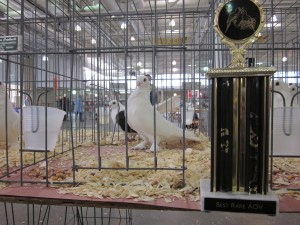
James: Best in Show, AOV, High Standard (HS). Des Moines ISPA Fancy Pigeon Show, December 2011. James is the founding Seraph cock of one of my Seraphim lines.
{The following little article is the first story I ever wrote about showing my Seraphim pigeons in the Iowa State Pigeon Association’s “Pigeons on the Prairie” annual competition at the fairgrounds in Des Moines. Most people in the United States are unaware of the Fancy Pigeon hobby, but it’s a big deal here and an even bigger deal throughout the rest of the world. The annual Des Moines show has about four thousand entries. There are about three hundred and fifty different breeds of fancy show pigeons in the world. Some compete as performance birds and others as show birds. There are judges and ratings for each individual bird or flock of performance birds. My special breed, the Seraph (Seraphim is plural), is an extremely rare fancy pigeon bred as a work of art and specifically for show purposes. To this day I keep them in my back garden and sell youngsters to other fanciers throughout the United States.}
My birds did very well at the 2011 ISPA Fancy Pigeon Show in Des Moines, all scoring from 92 to 95 on a scale of 100, with three birds scoring “High Standard” at 95 and three others @ 94. This experience with my twelve show birds exceeded my expectations. I’ve kept back eight of the twelve for breeding stock, including James, the Best in Show Seraph cock. Seahorse couldn’t compete since he had no band, but the judge scored him for me anyway and felt he was pushing a 96. He is the founder of another line of Seraphim in my loft. SuperJock likewise will be staying put, along with his son, GiantHead, a spectacular young cock still too young to breed but paired up with the best hen from the show. This is my breeding team for this year, and I am hoping for even more success next year.
In January all the birds will be set up for breeding. I can allow only a limited season due to space limitations, so if any of you fanciers out there want a pair of high-quality birds this year, drop me a line and I’ll breed extra designer birds just for you out of a combination of these great blood lines. You can reach me at cozmd@aol.com.
This is a bio of artist Lee Ver Duft that will be added to, subtracted from, updated, and corrected as more information comes in from various sources. It’s a great story, so enjoy!
There are way too many “secrets” in my family. I found out that Marlene Dietrich was my grandfather’s cousin, a fact that was kept secret from me because my mother thought she was a “bad influence” compared to the strictly religious conservative family she was raised in. Never mind all the work Ms. Dietrich did for the American troops in World War II, the movies she made, and her general super-stardom; her lifestyle was a “problem.” She did what she wanted during an era when women generally were not allowed such freedom. She’s a hero as far as I’m concerned, though. Good for her! (See related tale entitled “Parallel Universe” under “stories.”
Then I discovered a few years later that my father’s cousin, Lee Ver Duft, whom I never met, was an artist, poet, and author with friends all over the world and connections to the Chicago Art Institute and
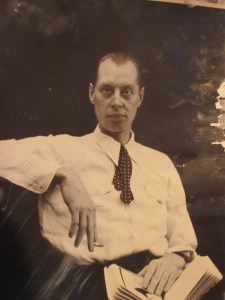
Artist/Poet Lee Ver Duft
various artists and authors in New YorkCity . I remember my father going to visit “Lee” now and then when I was a kid, but he never came to our house, and I never actually saw him. “Who is Lee?” I would ask. “Oh, just your Dad’s cousin”, Mom would reply. That was all I ever got out of them.
According to Mary Belle (Coster) Crosby (Dad’s sister and Lee’s first cousin) and my mother, Eleanor Ann (Felsing) Coster, as well as Lee’s own short bio discovered in the special collections at the University of Iowa library during my research, Lee (actually, Leo J. Ver Dught) was born in Prairie City, Iowa, on January 3rd, 1910, to my dad’s aunt, Bertha (Coster) Ver Dught and her husband John Ver Dught; the spelling of the last name was later changed to “Duft” instead of “Dught”. Bertha was one of four Coster sisters. Her brother, Cornelius John Coster, was my grandfather. Their parents immigrated from Amsterdam. Mary Belle told me there was a brother to Lee, Marion J., who was four years older and went by the name Joie (pronounced “joy”). (Confirmed by Gretchen Spencer from review of the 1920 and 1930 census from Marion Co., Iowa.)

Lee’s mother, Bertha Coster Ver Dught. The Coster’s emigrated from Amsterdam to Iowa around 1870.
Lee at age 5, 1915, with his dog Mike.
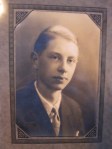
The graduate; 1928, age 18. Lee Ver Duft.
After graduating from the Prairie City High School in 1928, Lee attended Simpson College in Indianola, IA, in 1928-’29 and then transferred to Drake University in Des Moines where he majored in Music and minored in Art. After graduation he had summer internships in painting at the Chicago Art Institute and at the University of Iowa. After college he became a travelling showman and played the piano in dance and show bands. Places he called “home” in the 1930’s were St. Louis (MO), Newton (IA), and Eureka Springs (AK). His father John died in 1938, after which Lee moved to Venice Beach, CA, where he worked as a free-lance writer. He wasn’t there long before he moved on to graduate studies at Southwest Missouri State University in Springfield, MO, though he apparently did not finish his advanced degree.
In 1942 Lee enlisted in the Navy and was assigned as an Officer to Panama; he did administrative work. Lee was married twice; first while on leave from his Naval duties in Panama, but that marriage lasted “just one year, one month, and seven days” according to Lee’s own handwritten description of the marriage; he doesn’t even give her name! He was assigned to the Philippines in 1944 and given an honorable discharge at the end of WWII after serving a total of 28 months in the Navy.

Lee on Navy leave at Cafe Zanzibar in New York city circa 1943.
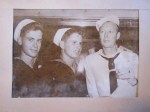
….and at The Three Deuces.
After returning to the United States, Lee moved to New York in 1946 and studied painting with the Parisian Cubist artist Amadee Ozenfant for seven months, and then with artist Hans Hoffman at the 8th Street Art School in New York and then in Provincetown until 1950. During the period from the mid-1930’s through the 1950’s Lee was very prolific, painting in watercolor and oil, sculpting, writing literally hundreds of poems, corresponding with authors and editors throughout the United States, and publishing a number of books of poetry as well as individual works in compiled volumes.
Lee’s first showing of his paintings and sculptures was in 1941 at the Des Moines Art Gallery; his second “One Man Exhibit” was there in 1946; the Grand Galleries in Des Moines served as the venue for his shows in 1951, 1956, 1961, and 1966. His final show, entitled “The 7th One-Man Exhibit Mini-Retrospective: Mixed Media painting 1946-1975 by Lee Ver Duft” was February 10th-24th, 1975 at the Younkers Gallery in Des Moines. Based upon Lee’s own written musings, it is clear that he “gave away” a good many paintings during this 30-year period, but he also sold a fair number. His work is described in the Des Moines Register as “avant-garde”, and the Des Moines Register Art Critic George Shane wrote of Lee’s 1967 show: “Over the many years I have come to know Lee Ver Duft’s artwork, his paintings have been in the vanguard of his contemporaries.” (The statement doesn’t really say much; it seems to me it was meant simply to be “Iowa nice.”)
In 1945 Lee was living on Rock City Road in Woodstock, New York, from whence he dedicated an advance copy of his 1946 book of poetry “Ho! Watchman of the Night Ho!” to Miss Peggy Guggenheim at Art of This Century, 30 W. 47th St. New York, NY, with the following inscription: “Dear Peggy, how about lunch this year? Out of this, my night, and this, your century, ‘we are those who could be’. Most Regardfully, Lee Ver Duft; December 1945.” The publisher – Gemor Press – was owned and operated by Anais Nin, the infamous avant-garde New York author who titillated the country with her erotic writings. Lee spent much time in New York City in the ’40’s hanging out at clubs such as Club 66 at 66 West 3rd St in Greenwich Village, Club 181 at 181 Second Ave., a hopping gay/lesbian club with famous drag shows, the Three Deuces, a club sponsoring the best in African American jazz musicians, and Cafe Zanzibar, atop the Winter Garden Theatre on Broadway, the place to see and be seen and to listen to famous musicians. There is no doubt he was acquainted with many in the avant-garde art scene and writers’ crowd there in that decade. Books of his published in this time period include: “The Double Heart & Other Poems,” Panama Publishers, New York, 1948; and “Inner Course in Time, Flesh, & Eidolon,” Decker Press, Prairie City, IL, 1948. There are unpublished poems from this period almost too numerous to count in the special collection’s archives at the University of Iowa.
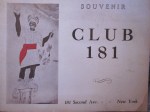
The cover of a photo book holding a picture of Lee Ver Duft at Club 181 in New York.

Lee in the Club 181 photo-book. This famous gay club closed in 1953.
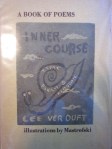
One of Lee’s books of Poetry.

…and another book of poetry by Lee.
Lee’s second marriage was to Agnes Morrison Clausen on December 12th, 1953; she was a native of southern

Lee Ver Duft’s second wife, Agnes.
California and of “Scottish descent.” The two of them spent a great deal of time in Venice and Palm Springs, CA. Though they remained close, this marriage too apparently ended in divorce within a couple of years, according to Eleanor Coster and Gretchen Spencer.
Lee’s late poetry publications include “Ballad of the Bally Daredevil,” Zeno Publications, Des Moines, 1968; “Five Longer Older Poems & Two Recent Short 1946-1976, 1976; and “Bicentennial Entropy and Dust” (A single poem on page 40 of a multiple author collection of poetry called “Panorama – A Bicentennial Anthology,” by Max S. Barker, Bifco Press, Marshalltown, IA.
Lee seemed to have a lot of friends and acquaintances, but he seemed to have been particularly close to the Iowa poet Frederick Bock, and the well-known artist/photographer Donald Jones who painted the fresco in the Des Moines public library in 1934 and who died on April 14th, 1984, of a heart attack in a hospital near his home in San Francisco at age 80.
Lee lived in Des Moines, Iowa for the majority of his late life. Addresses included 2417 Woodland Ave, #2 in 1975; and 1112 27th St., #3, unknown dates. He died in April of 1985 at the age of 75 of a brain tumor, possibly metastatic from a breast cancer for which he had a mastectomy around 1982, about which he sent a letter to my dad. Dad and Mom and Mary Belle went to his place to sort out his things after his death because he had no other family remaining in the area to take care of it. Joie had died in 1977. A lot of his stuff was put in Mom’s basement, which wasn’t dry, and it was destroyed over time due to the conditions down there. Other items went to Mary Belle, most of which she took to Des Moines to the Iowa State Historical Museum. His remaining papers from there were transferred to the University of Iowa special archives in 2008. Mom kept and hung a couple of his paintings in the living room, one of which I now have, along with a beautiful side-table of Lee’s.
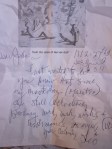
A few years ago, when I was visiting Mom and she was thinking of moving out of the old house, I came upon a pile of Lee’s stuff in the basement, nearly all ruined. There I found a small, rusted metal box, and in it a sheaf of letters to and from his boyfriend in Cuba, with whom he was clearly very much in love. “So, THIS is why I was never allowed to meet this man!” I thought to myself. In truth, however, Mom says she never knew that Lee was gay and suspected it only for the first time when going through his things after his death, though Dad probably always knew. It was not something ever discussed back then. Mary Belle says she knew it though, even though they never talked about it.
The letters I found were barely legible due to water damage, but I eventually made out the story of a long-distance love relationship with letters from each over a period of about five years. It became clear the relationship was falling apart as the discourse became more and more pained over time. The story made me feel very badly for the two of them, in love but unable to be together for social and distance reasons, and eventually they went their separate ways. There was a lot of anguish in the last few letters. I was unable to preserve the documents due to the damage done to them. They were literally falling apart before my eyes.
I remembered, in retrospect, hearing Mom and Dad whispering in the kitchen shortly after Lee’s death about some of the things they found at his apartment, including some male nudes and some campy photos of Lee wrapped in a boa. I asked to see them, but they said they and Mary Belle had destroyed them all. “It’s not the sort of thing you need to see!” they exclaimed. Apparently, there was nothing at all about Lee they wanted me to see. But the letters to his Cuban boyfriend gave me a glimpse of what I didn’t get to see: the complex hidden and public life of a gay artist in mid-20th century America.
Gretchen Spencer of central Iowa remembers as a teenage meeting Lee at an old Victorian house in the Drake University neighborhood in Des Moines in 1956. At 46, Lee was apparently back home living with his mother, out of money, out of work, and just back from New York. He had an exhibition of his work at the Des Moines Art Center at the time, and he was “dating” (?) a friend of Gretchen’s mother, a recent divorcee named Francesca, who lived at the house. Lee played Stardust and Rhapsody in Blue on the piano from memory that evening after mixing martinis, and then went out with Fran and Gretchen’s mother for dinner at Babe’s restaurant in downtown Des Moines, the most famous night spot in the city – dressed in white bib overalls, a tuxedo shirt, a tie, and a sport-coat, as Gretchen recalls! He was tall, slender, courtly, and a gentleman. He made a tremendous impression on her that night and she has never forgotten him.
Below is a series of photos of actual paintings, along with digital photos of old pictures of paintings found in Lee’s effects after his death. I know there are more out there in the world – probably quite a few. So, if anyone reading this article happens to have one, please take a good digital photograph and send it to me, along with any information you have about the piece, at cozmd@aol.com, so I may include it in this bio.
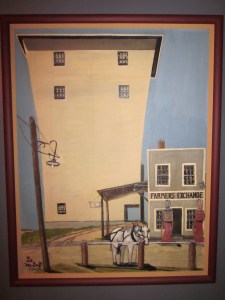
Farmers Exchange; 1940 oil on wood, by Lee Ver Duft. Painted from the Prairie City town square.
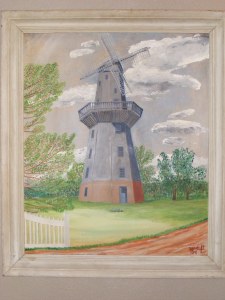
Waterbury Circle Windmill, 1941 oil on wood by lee Ver Duft.
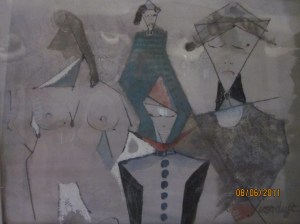
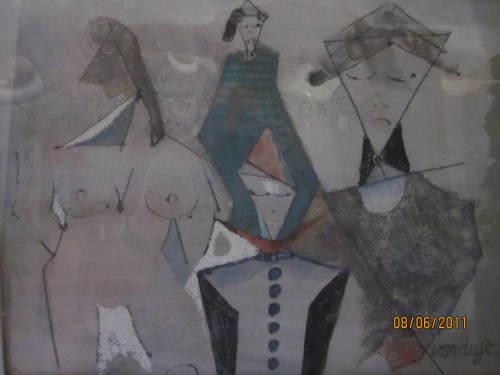
Untitled 1950 (c) cubist-style watercolor on textured paper by Lee Ver Duft.
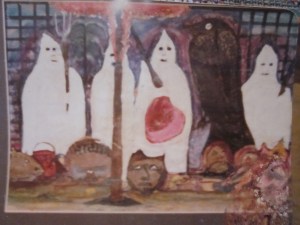
Unknown title, date, and medium. Lee Ver Duft, from photo files.
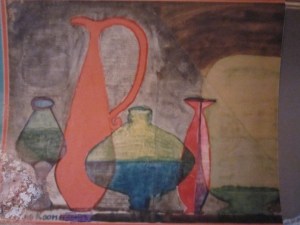
Abstract Lee VerDuft, unknown date, title, and medium.
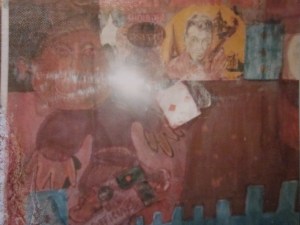
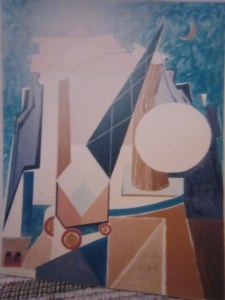
A cubist-style Ver Duft, unknown details.
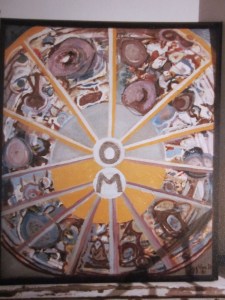
“Our Macule – A Meditation Piece” by Lee Ver Duft
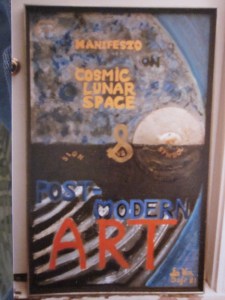
Unknown Title, 1981 Lee Ver Duft
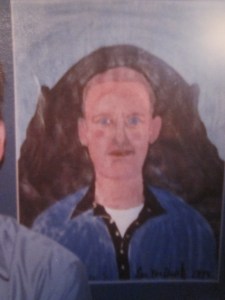
A 1979 Lee Ver Duft portrait of a man.

A 1974 Ver Duft.
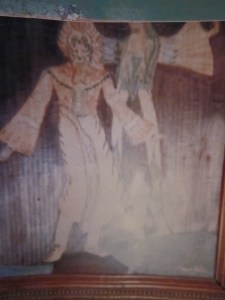
This photo was found in the Iowa City archives and misidentified as a Lee Ver Duft. In fact, it is a painting by artist Mark Tobey called “Shamanic Dancers” that was in Lee’s personal collection. It is crayon and gouache on paper. It was up for sale by Swann Auction Galleries in New York on March 23rd, 2023, with an estimated value of $3,000 to $5,000. (Information from Meagan Gandolpho at Swann Auction Galleries, email, 3-2-23.)
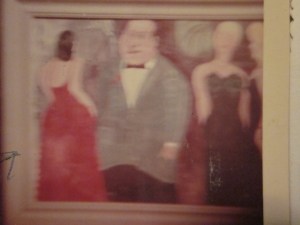
“Maitre’d”. A 20×24 Lee Ver Duft oil that was stolen on August 16, 1965, and never recovered. This photo is badly out of focus, but it’s a very interesting work.
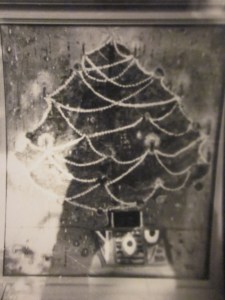
“Christmas Tree” A 25×30 Ver Duft oil that was stolen in its frame on August 16, 1965, and never recovered.
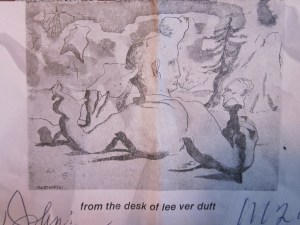
Lee Ver Duft’s original wood block personal letterhead stamp.
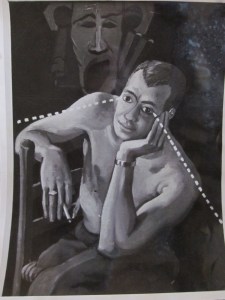
A nearly completed Lee Ver Duft oil self=portrait. 1940.
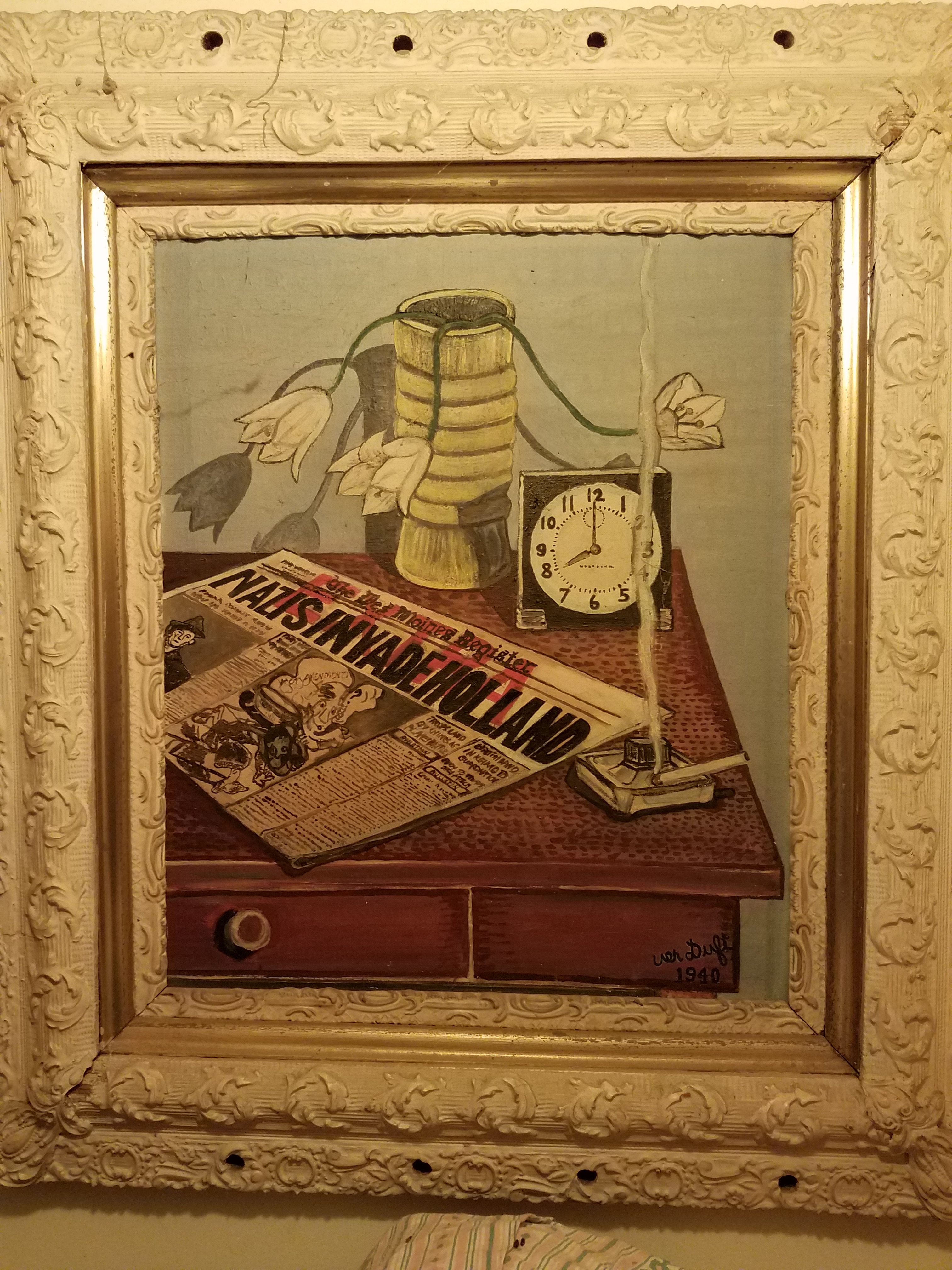
The photo of the above painting, “Nazis Invade Holland,” was provided (May 2018) by my cousin Paul Crosby. The painting was owned by Mary Belle (Coster) Crosby, Paul’s mother (my father John Coster’s sister) and the 1st cousin of Lee Ver Duft. I think this is a great painting, not just for its content and the way it depicts the feeling of the time, but the overall style. Wonderful!
Sources:
Personal History from MaryBelle (Coster) Crosby of Fremont, Iowa (cousin of Lee Ver Duft).
Personal History from Eleanor Coster of New Sharon, Iowa (cousin-in-law of Lee Ver Duft).
Personal papers, newspaper articles, letters, photographs, yearbooks, and memorabilia.
Personal History from Gretchen Spencer of Des Moines, Iowa.
Special Thanks to:
The University of Iowa Libraries, Iowa City, Iowa, Special Archives.
Iowa Authors Manuscripts Collection, MsC 869, Box 20 (Lee Ver Duft papers and photographs)
 Coz
Coz 